Table of Contents
- Why Upgrading Factory Pistol Triggers Matters for Competition
- Competition Trigger Pull Weight Standards
- How to Install a Drop-In Trigger Kit
- USPSA Production Class Trigger Rules
- Flat-Faced vs Curved Triggers: What Actually Helps
- Reliability Trade-Offs and Maintenance for Competition Triggers
- Dry Fire Training to Master Your New Trigger
- Conclusion
- Frequently Asked Questions
Last Updated: September 29, 2026
Why Upgrading Factory Pistol Triggers Matters for Competition
Most factory triggers are engineered for liability, not for speed. That’s why upgrading factory pistol triggers for competition is one of the highest-return changes you can make to a stock pistol. Polymer Pew offers drop-in trigger kits and lower receivers for exactly this reason: the factory part is the bottleneck, and everything downstream of it, from split times to sight picture, improves once you fix it.
A stock striker-fired trigger typically ships with a heavy, gritty break and a long reset, forcing the shooter to compensate with grip pressure and timing rather than pure trigger control. Competition scoring punishes that on every stage.
Most guides treat a trigger upgrade as a “feel” improvement. It isn’t. It’s a control improvement, and control is what the clock measures.
A trigger upgrade doesn’t make you faster by itself. It removes the mechanical slop that forces you to slow down, which is a different and more useful thing.
Competition Trigger Pull Weight Standards
The practical range for a competition trigger is roughly 2.5 to 4 pounds, with most shooters settling between 3 and 3.5. Lighter isn’t automatically better: below about 2.5 pounds, the margin for error on a moving stage collapses, and a bump against a barrier or a hurried reload can send a shot you didn’t intend.
What most guides skip is that pull weight is a division question before it’s a preference question. In USPSA, Production division requires a minimum trigger pull of 5 pounds for the first shot in double-action mode on pistols with a hammer, while striker-fired pistols in Production and Carry Optics have no stated minimum but must remain in factory configuration for external parts. IDPA’s Stock Service Pistol division sets a 3.5-pound minimum for the first shot, and Enhanced Service Pistol allows more latitude. The USPSA Competition Rules and the IDPA rulebook are the controlling documents, and both are revised on a cycle, so verify the current edition before you build to a number.
That means the ‘right’ weight depends on where you’re shooting. A 3-pound trigger that feels perfect in Carry Optics can put you in a different division, or out of compliance, in SSP. Build to the division, then tune within it.
Understanding Pre-Travel, Wall, and Over-Travel
Pre-travel is the distance the trigger moves before the sear is about to release. The wall is that point of resistance where the trigger stops moving freely and starts loading the sear. Over-travel is how far the trigger continues past the break.
Each one changes how the pistol behaves in your hands:
- Pre-travel: shorter travel means the shot arrives sooner after your decision to fire
- Wall: a defined wall lets you prep the trigger during the draw and on transitions
- Over-travel: excess over-travel pushes the muzzle off target and slows your reset
Adjustable over-travel screws exist on many aftermarket triggers for this reason. Set them so the trigger stops just past the break, then back it out a quarter turn if the reset feels sluggish.
How Spring Weight Changes the Equation
Pull weight is mostly a function of three springs: the trigger return spring, the striker spring (on striker-fired pistols), and the sear spring on hammer-fired designs. Reducing the striker spring is the fastest way to lighten the break, but also the fastest way to introduce light strikes. A common pattern pairs a reduced-power striker spring with an extended firing pin and lighter firing pin spring to preserve ignition energy, and that’s exactly where the reliability trade-off lives.
Most practitioners find that a 4-pound striker spring is the practical floor for reliable ignition with common factory ammunition, and that going below it demands either softer primers, a longer firing pin, or both. If you shoot in cold weather or run hard-primer ammunition, keep more margin than you think you need.
Pull weight is a division compliance number first and a feel preference second. Pick the weight your division allows, then tune springs and geometry inside that box.
How to Install a Drop-In Trigger Kit
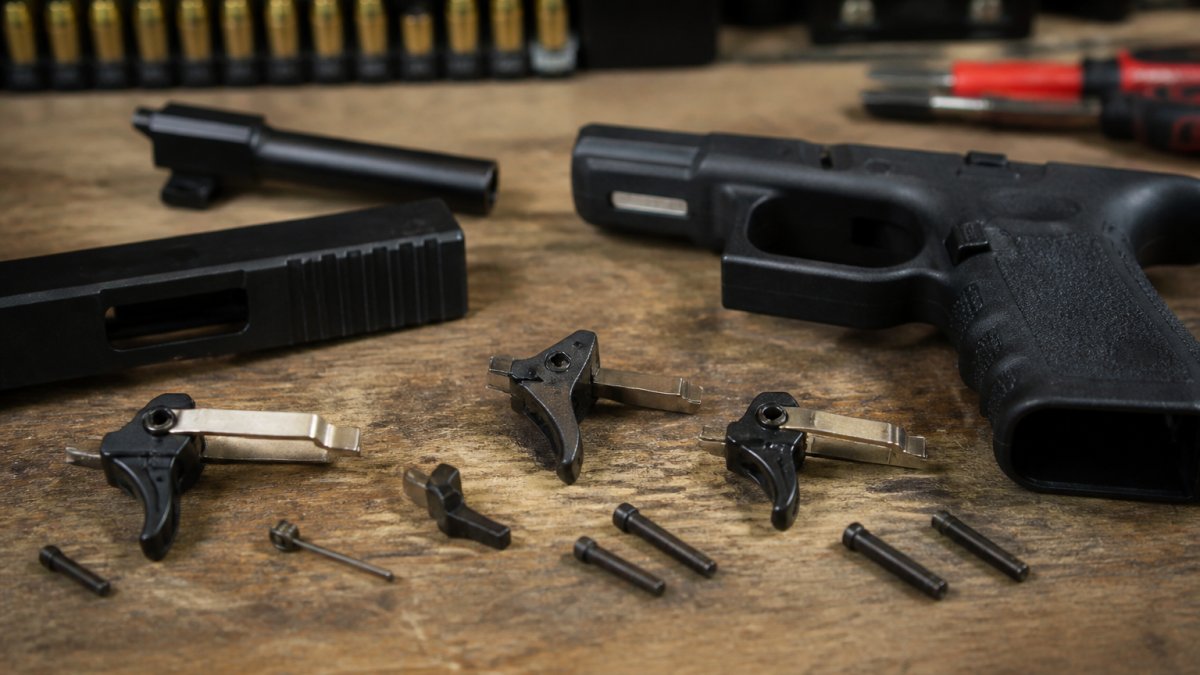
A drop-in trigger kit replaces the trigger, connector, and often the springs without fitting to the frame. Installation takes most shooters 20 to 40 minutes with basic punches and a bench block; first-timers should budget closer to an hour.
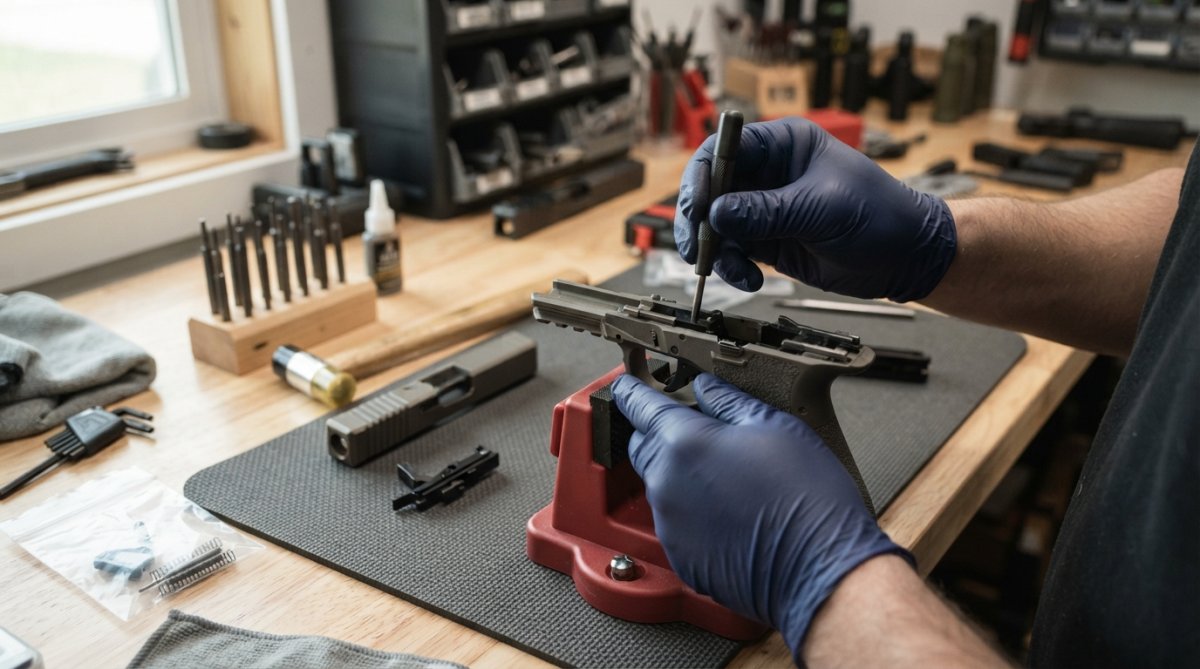
Before you start, confirm your kit matches your specific generation and model. A Gen 3 kit won’t seat correctly in a Gen 5, and forcing it is how people end up with a pistol that won’t cycle.
- Clear the pistol completely and remove the magazine, then field-strip it and separate the slide from the frame.
- Drive out the trigger pin and the trigger housing pin with a roll pin punch, working from the correct side.
- Lift out the trigger assembly and connector, noting the orientation of the connector bend before it comes free.
- Install the new connector and trigger bar, seating the connector fully against the housing.
- Reinstall the trigger housing, then the trigger pin, tapping until the pin sits flush.
- Reassemble the slide, rack it several times, and dry fire to confirm reset and break.
- Function-test with dummy rounds before you load live ammunition.
Common Mistakes to Avoid During Installation
The most common mistake is bending the connector to “smooth out” the trigger. Connector angle controls the break and reset, and too aggressive a bend produces a trigger that won’t reset reliably. Adjust the springs or the over-travel screw instead.
A second mistake is reusing worn pins.
Skipping the function test with dummy rounds is how people discover a problem at the range instead of at the bench. A trigger that fails to reset under recoil is a stage-ending malfunction, and it’s almost always caused by something you could have caught in five minutes of dry cycling.
USPSA Production Class Trigger Rules
Production division limits what you can change, and the rules are stricter than most shooters assume. Internal trigger components may generally be replaced, but the pistol must remain in factory-produced configuration for external parts, and any modification that changes external dimensions or adds a visible aftermarket part can move you out of the division.
Flat-Faced vs Curved Triggers: What Actually Helps
Flat-faced triggers win on consistency, not looks. The flat shoe presents the same surface to your finger regardless of placement, so your press is repeatable from the draw, from a reload, and from a weak-hand position.
The Division-Legality Wrinkle Most Guides Ignore
Here’s the angle almost no guide covers: a flat-faced trigger shoe is an external component, and that matters for classification. In USPSA Production and Carry Optics, internal trigger parts, springs, connectors, trigger bars, are generally replaceable, but the pistol must remain in its factory-produced external configuration. A flat-faced aftermarket shoe can be read as an external modification, which is why some shooters who install one find themselves bumped to Limited or Open.
The Adjustment Period Nobody Talks About
New trigger geometry changes where your finger indexes, costing you time until you retrain it. Expect a two-to-three-week adjustment window before split times return to baseline, spend it in dry fire, not at a match.
Maintenance and Reliability Trade-Offs
A flat shoe with a lighter spring runs closer to the edge of reliable ignition than a factory trigger does. The reliability questions worth asking before you commit:
- Will the pistol still ignite hard primers reliably in cold weather?
- Does the trigger reset consistently when the pistol is dirty?
- Are you willing to clean the fire control group more often than you would with a stock trigger?
Shooters who compete regularly and want a trigger that stays consistent across reloads, transitions, and weak-hand strings, and who are willing to verify division legality and commit to a dry-fire adjustment period.
Reliability Trade-Offs and Maintenance for Competition Triggers
Lighter springs and reduced sear engagement buy a better trigger and cost you margin. A competition trigger runs closer to the edge of reliable ignition than a factory trigger does, and that trade-off is real.
The reliability questions worth asking before you commit:
- Will the pistol still ignite hard primers reliably in cold weather?
- Does the trigger reset consistently when the pistol is dirty?
- Are you willing to clean the fire control group more often than you would with a stock trigger?
Dry Fire Training to Master Your New Trigger
Dry fire is where the new trigger pays off. Ten minutes a day for two weeks will do more for your split times than any part you can buy.
Conclusion
The gap between a factory trigger and a competition trigger isn’t about feel. It’s about how much attention the trigger steals from the shot, and how much you get back once the mechanical slop is gone.
Frequently Asked Questions
Are trigger upgrades worth it for competitive shooting?
Yes, if you shoot USPSA, IDPA, or steel challenge regularly. A cleaner break and shorter reset can cut split times and tighten groups. The gains come from reducing pre-travel and over-travel, not from chasing the lightest possible pull. A drop-in kit from a reputable maker gives you consistent sear engagement and a predictable wall, which matters more than raw pull weight for most competitors.
Do competition trigger upgrades affect firearm reliability?
They can. Lighter springs and reduced sear engagement leave less margin for error, especially with hard primers or cold weather. A polished sear and a quality connector help, but you should run at least 300 to 500 rounds through any new trigger before trusting it in a match. Keep the factory trigger group on hand as a backup.
What is the minimum trigger pull weight for USPSA Production class?
USPSA Production requires a minimum trigger pull of 5 pounds for the first shot, measured with a gauge. This applies to double-action, striker-fired, and safe-action pistols in that division. If you are running a hammer-fired gun, the single-action pull must also meet the 5-pound minimum. Check the current USPSA rulebook before your next match because divisions and rules update periodically.
How do I know if a drop-in trigger kit will fit my pistol?
Fit depends on your specific platform and generation. A kit made for a Gen 3 Glock will not drop into a Gen 5 without modification. Check the maker’s compatibility chart, confirm your frame and slide generation, and look for kits that include a new trigger housing and connector. If you are building a clone, verify that the lower accepts standard trigger groups before ordering.