Table of Contents
- How Trigger Geometry Affects Accuracy
- Flat vs Curved Trigger Pros and Cons
- The Biomechanics of Flat Faced Triggers: Why Use Matters
- Finger Placement and Consistent Shot Placement
- Best Drop-In Triggers for Precision
- Dry Fire Training with Flat Faced Triggers
- Conclusion
- Frequently Asked Questions
Last Updated: September 28, 2026

How Trigger Geometry Affects Accuracy
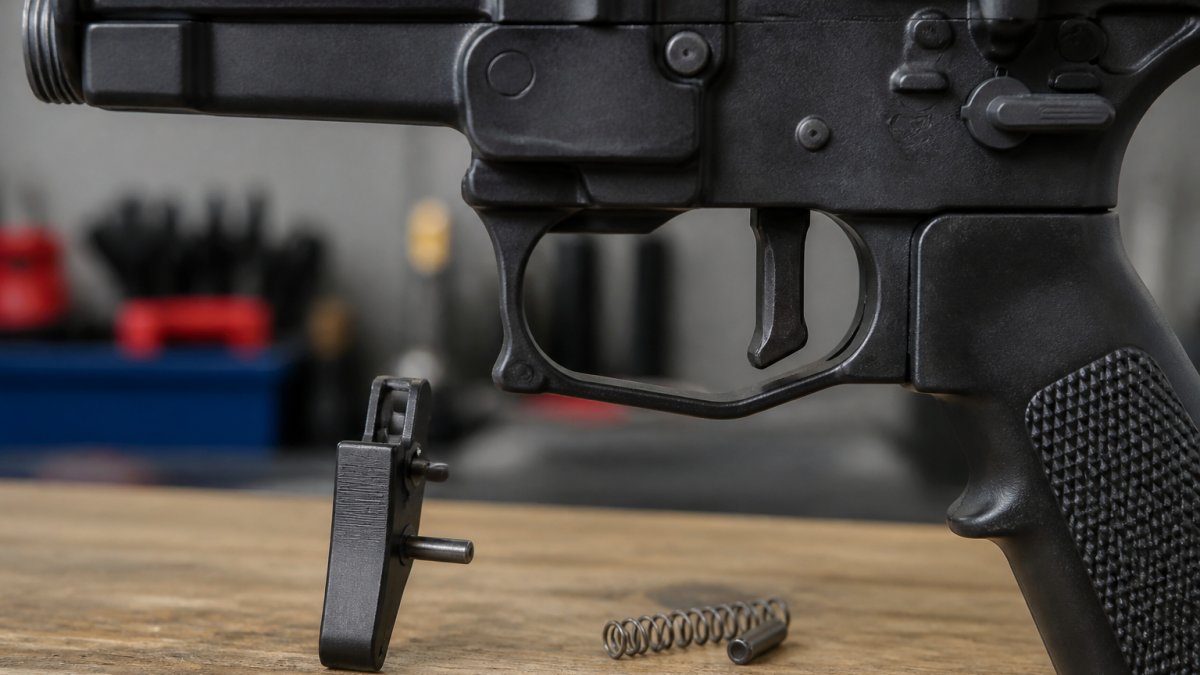
Trigger geometry is the shape, angle, and curvature of the trigger face, and it determines how your finger transfers force to the sear. A flat face gives one consistent point of contact; a curved face lets your finger settle differently on every press. That difference compounds over dozens of shots, which is why the benefits of flat faced triggers for accuracy come down to repeatability rather than magic. Polymer Pew builds flat trigger components for shooters who want that repeatability.

Here’s the short version: your trigger finger is a lever, and the trigger face is the fulcrum it pushes against. Change the shape of that fulcrum and you change how much of your finger’s motion translates into a clean break versus sideways deflection. The SAAMI standards for firearm and ammunition performance give manufacturers a common baseline for how components must perform, but trigger face geometry is largely a shooter-fit decision, not a spec sheet number.
If you’ve shot a group that felt good and then watched it string sideways, geometry is a likely culprit. Below, we’ll cover how flat and curved faces compare, what the biomechanics do, and how to train the difference.
Flat vs Curved Trigger Pros and Cons
Flat triggers win on consistency; curved triggers win on familiarity. Neither profile is universally more accurate, the profile that matches your hand and shooting task is the one that tightens groups.
Flat face advantages:
- Consistent point of contact regardless of where your finger lands on the shoe
- Straight-back press path that reduces lateral deflection
- Clear tactile feedback at the trigger break
- Better use at the bottom of the shoe for shooters with longer fingers
- Easier to index the same spot shot after shot, which is the core of repeatability
Curved face advantages:
- Familiar feel for shooters raised on factory triggers
- The curve can help center a finger that tends to drift
- Often preferred for heavy-pull, double-action platforms where the longer arc suits a rolling press
- More forgiving when your grip shifts between strings
Where flat faces fall short:
- Less forgiving if your finger placement is inconsistent
- Some shooters need a break-in period to adjust
- Not every platform has a quality flat option available
- On very short fingers, the lower use point can make the trigger feel heavier than its rated pull weight
| Factor | Flat Face | Curved Face |
|---|---|---|
| Contact consistency | High | Varies by finger position |
| Press path | Straight back | Can arc slightly |
| Learning curve | Moderate | Low |
| Best for | Precision and competition | General use, DA revolvers |
| Finger-length fit | Favors medium-to-long fingers | Tolerant of short fingers |
The anatomy variable most comparisons ignore
The biggest factor in whether a flat face helps you is not the trigger, it’s your hand. Two shooters can run the same rifle and get opposite results because their index fingers reach the trigger differently.
- Long fingers (roughly 3.5 inches or more from the web of the hand to the fingertip): A flat face lets you place the pad low on the shoe, which increases your mechanical advantage and makes a given pull weight feel lighter. This is where flat triggers show the clearest accuracy benefit.
- Short fingers (under about 3 inches): You tend to press higher on the shoe, closer to the pivot. On a flat face that raises perceived pull weight and can push you toward a fingertip press, which introduces the sideways lever effect. A curved face may actually index more naturally here.
- Average fingers: Either profile works. The deciding factor becomes which one you can index the same way on every press without thinking about it.
A quick test: with an unloaded firearm, close your eyes, mount the gun, and press. Open your eyes and see where your finger landed. Do it ten times. If your landing spot moves more than about a quarter inch on a flat face, your grip consistency is the problem, and no trigger swap will fix that.
The table above is a starting point, not a verdict, the right answer depends on your hand, your platform, and your target.
The Biomechanics of Flat Faced Triggers: Why Use Matters
Flat faced triggers improve accuracy because a flat surface keeps your finger’s force vector pointed straight back toward the sear instead of letting it slide up or down the curve. The size of that benefit depends heavily on how fast you’re shooting.
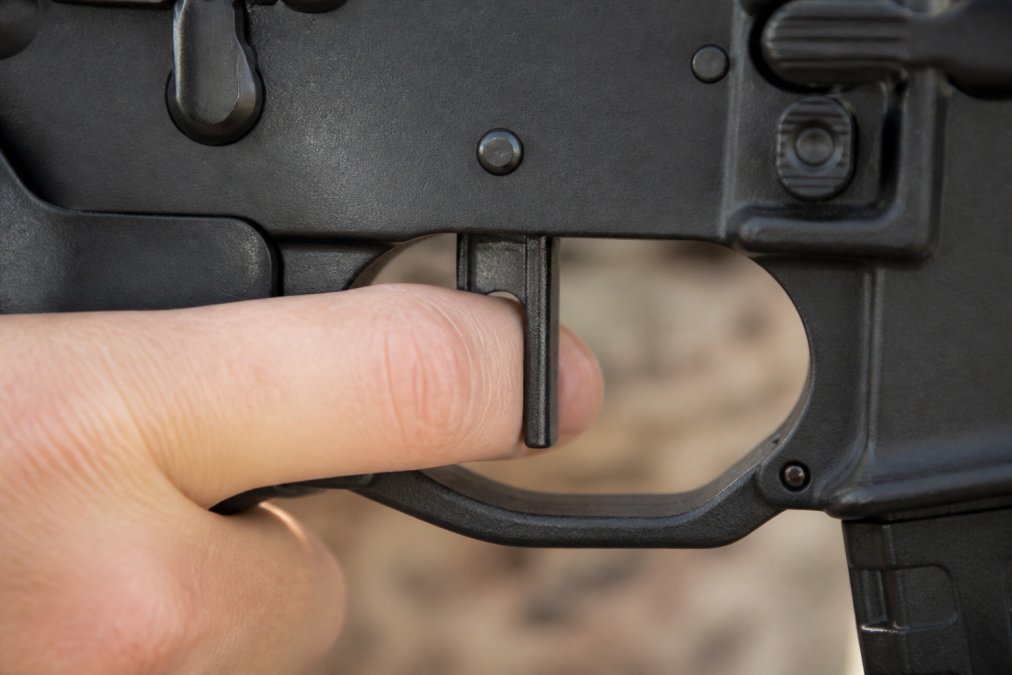
Maintaining this consistent, linear trigger pull requires a stable foundation provided by proper carry gear that prevents shifting during the draw.
On a curved trigger face, your finger slides toward the deepest part of the curve as you press. That slide adds a vertical component to your force, and vertical force translates into muzzle movement. A flat face eliminates the slide, so your finger pad stays put and the force goes where you point it.
There’s a second mechanism too: the moment arm. Your finger is a lever pivoting at the knuckle, and the trigger face is where that lever meets resistance. On a curved shoe, the contact point migrates as you press, changing the effective moment arm mid-press. On a flat shoe, the contact point stays fixed, so leverage is identical from the start of the press to the break, and that consistency shows up on target as smaller groups.
The use point on a flat trigger sits lower on the shoe than on most curved designs. If you have shorter fingers, this can actually make the trigger feel heavier because you’re pressing closer to the pivot. Test before you commit.
Precision fire vs. rapid fire: where the flat face pays off most
“Accuracy” isn’t one thing. The flat-face advantage behaves differently depending on your firing cadence, and that split tells you whether the upgrade is worth it for your discipline.
Slow precision fire (benchrest, long-range, one shot every several seconds): Here the flat face’s value is repeatability of contact. You have time to settle and press deliberately, so the variable you’re fighting is whether your finger lands in the same spot each time. A flat shoe gives you a fixed landing zone; a curved shoe gives you a moving one. For shooters chasing sub-MOA groups, this is the strongest case for going flat.
Rapid fire (action shooting, high-cadence strings, split-time drills): At speed you’re not carefully indexing, you’re slapping or rolling through the trigger as fast as you can reset.
Finger Placement and Consistent Shot Placement
A few placement rules that hold up in practice:
- Use the pad, not the crease of the joint, for better control
- Keep the finger perpendicular to the face so force goes straight back
- Let the trigger reset fully before the next press
- Watch for over-travel, which pushes the muzzle off target after the break
The most common mistake with flat triggers is pressing with the fingertip. It feels precise, but it introduces a lever effect that pulls the muzzle sideways. If your groups string left or right, check your finger position before blaming the trigger.
Dry fire is where you fix this cheaply. More on that below.
Best Drop-In Triggers for Precision
The best drop-in trigger for precision shooting combines a flat face, minimal creep, and a clean reset without a gunsmith. Here’s how some options compare, starting with our own.
| Trigger | Starting Price | Best For |
|---|---|---|
| Polymer Pew | Varies by kit | Clone builds and budget precision |
| Timney Alpha | ~$150 | Competition shooters |
| Overwatch TAC | ~$135 | High-stress precision |
| Geissele SD | ~$240 | Match-grade rifles |
| Apex Tactical | ~$125 | Specific handgun models |
Dry Fire Training with Flat Faced Triggers
A simple dry fire routine:
- Confirm the firearm is clear and remove all ammunition from the room
- Use a safe backstop or training barrel if your platform allows it
- Press the trigger slowly, watching for any muzzle movement
- Reset and repeat, focusing on identical finger placement each time
- Mix in rapid presses to test whether your form holds under speed
Dry fire with a flat trigger teaches you where your finger actually lands, not where you assume it lands. That feedback loop is worth more than any single upgrade.
Once your dry fire groups are consistent, live fire confirms it. Expect the first range session after a trigger swap to feel unfamiliar. That’s normal, and it usually resolves within a few hundred rounds.
Conclusion
The benefits of flat faced triggers for accuracy come down to one thing: a flat face removes variables. Consistent contact, straight-back press, cleaner feedback, and a repeatable break. Pair that with dry fire practice and a trigger matched to your platform, and your groups will tighten.
Frequently Asked Questions
Do flat faced triggers actually improve shooting accuracy?
Yes, for most shooters. Flat faced triggers provide a uniform contact surface that encourages consistent finger placement and straight-back pressure. This consistency reduces lateral input on the trigger shoe, which translates to tighter shot groupings. The improvement is most noticeable for shooters who struggle with finger placement on curved triggers, particularly during rapid fire or when wearing gloves.
Which trigger is better, a flat trigger or a curved trigger?
It depends on your shooting style and hand anatomy. Flat triggers offer more consistent leverage and a wider contact surface, which helps with uniform pressure and repeatable trigger breaks. Curved triggers suit shooters with smaller hands or those who prefer a traditional feel. For precision shooting and competition, flat triggers are often preferred because they reduce variation in finger placement between shots.
Are flat triggers better for rapid fire or precision shooting?
They benefit both, but for different reasons. In precision shooting, the flat face promotes consistent finger pad contact and straight-back pull for tighter shot groupings. During rapid fire, the flat surface helps maintain muzzle control because your finger stays in the same spot through the reset. The reduced over-travel common in flat trigger designs also helps you get back on target faster.
Do flat triggers change the perceived pull weight of a firearm?
They can. A flat trigger face distributes pressure across a wider area of your finger pad, which often makes the same pull weight feel lighter and smoother. The geometry also changes your mechanical advantage, so you may perceive a lighter trigger break even when the actual pull weight is unchanged. This is one reason shooters report better trigger control after switching to a flat shoe.