Table of Contents
- What Makes Budget Weapon Parts Reliable
- Essential vs Non-Essential Firearm Upgrades
- How to Spot Counterfeit Gun Parts
- Testing Firearm Components for Safety
- Compatibility Verification Protocols
- Material Quality and Manufacturing Standards
- Maintenance Requirements for Budget Parts
- Frequently Asked Questions
Last Updated: September 23, 2026
What Makes Budget Weapon Parts Reliable
Choosing reliable budget weapon parts means understanding which components demand premium quality and which ones can safely operate at lower price points. The difference between a catastrophic failure and dependable performance often comes down to material selection, manufacturing standards, and honest assessment of what “budget” actually means for each component type.
The buy once cry once philosophy dominates firearm discussions for good reason. A lower receiver that cracks mid-competition costs far more than the difference between budget and quality options. But applying that logic uniformly across every part wastes money on components where budget alternatives work perfectly well.
The Buy Once Cry Once Philosophy
This approach prioritizes long-term reliability over initial cost. When you’re choosing reliable budget weapon parts, the philosophy means spending more upfront on critical components to avoid replacing them repeatedly. A quality bolt carrier group with proper heat treatment and magnetic particle inspection might cost more initially, but it cycles reliably for thousands of rounds without degradation.
The real insight is selective spending. You don’t apply buy once cry once to every part equally. Some components genuinely fail under stress, these demand premium materials and manufacturing. Others operate in low-stress environments where budget options perform identically to premium versions. The skill is knowing which is which.
Critical vs. Non-Critical Components
Critical components directly affect safety, reliability, and longevity. These include the bolt carrier group, firing pin, hammer, trigger assembly, and lower receiver. They experience high pressures, repeated stress cycles, and direct contact with hot gases. Failure here means malfunction, potential injury, or complete platform destruction.
Non-critical components tolerate budget alternatives much better. Handguards, rail systems, grips, and charging handles rarely fail regardless of material quality. They don’t experience pressure cycling or thermal stress. A polymer handguard from a budget manufacturer works identically to a premium aluminum version for most shooters.
The tolerance stacking concept becomes crucial here. Critical components must maintain dimensional accuracy across multiple build cycles. Non-critical parts have looser tolerances because their function doesn’t depend on precision fit or pressure resistance.
Essential vs Non-Essential Firearm Upgrades
Understanding the difference between upgrades that genuinely enhance performance and those that exist purely for aesthetics saves money and prevents buyer’s remorse.
Where to Spend More
Invest in components where reliability directly impacts function. A quality trigger assembly with consistent pull weight, minimal creep, and predictable reset matters for accuracy and safety. Budget triggers often have wildly inconsistent pull weights, some days 4.5 pounds, other days 5.5 pounds. This inconsistency ruins precision shooting and creates safety concerns.
Gas system tuning demands attention too. Oversized buffer systems, properly selected gas tubes, and quality recoil springs absorb the recoil impulse more effectively. A muzzle device rated for your specific platform prevents baffle strikes and premature wear on the upper receiver. These upgrades directly affect cycling reliability and component longevity.
Polymer Pew’s aluminum MKE lower receivers with hardened stainless steel internals represent this category perfectly. The lower receiver bears the serial number and technically constitutes the firearm itself. Budget lowers sometimes have casting defects, improper heat treatment, or dimensional inaccuracy that causes binding issues. A quality lower ensures drop-in compatibility with various platform variants and maintains structural integrity through thousands of cycles.
Where Budget Options Work
Handguards, rail systems, and ergonomic accessories tolerate budget alternatives without performance loss. A budget polymer handguard dissipates heat adequately and provides rail space for mounting optics. The difference between a $30 and $120 handguard is aesthetics and weight savings, not functional reliability.
Charging handles, safety levers, and magazine catches function identically whether budget or premium. These components experience minimal stress and rarely fail. Spending premium prices here represents poor resource allocation when that money could strengthen critical components.
Muzzle devices sit in a middle category. Budget flash hiders work acceptably for most shooters, but quality devices with proper dimensional accuracy prevent baffle strikes and reduce muzzle rise more effectively. If you’re building a competition platform, invest here. If you’re building a budget utility rifle, a basic flash hider suffices.
How to Spot Counterfeit Gun Parts
Counterfeit components represent the biggest risk when shopping budget options. Counterfeiters target high-demand parts, bolt carrier groups, triggers, and lower receivers, because demand creates opportunity. Identifying fakes before purchase prevents dangerous failures and wasted money.
Red Flags in Packaging and Markings
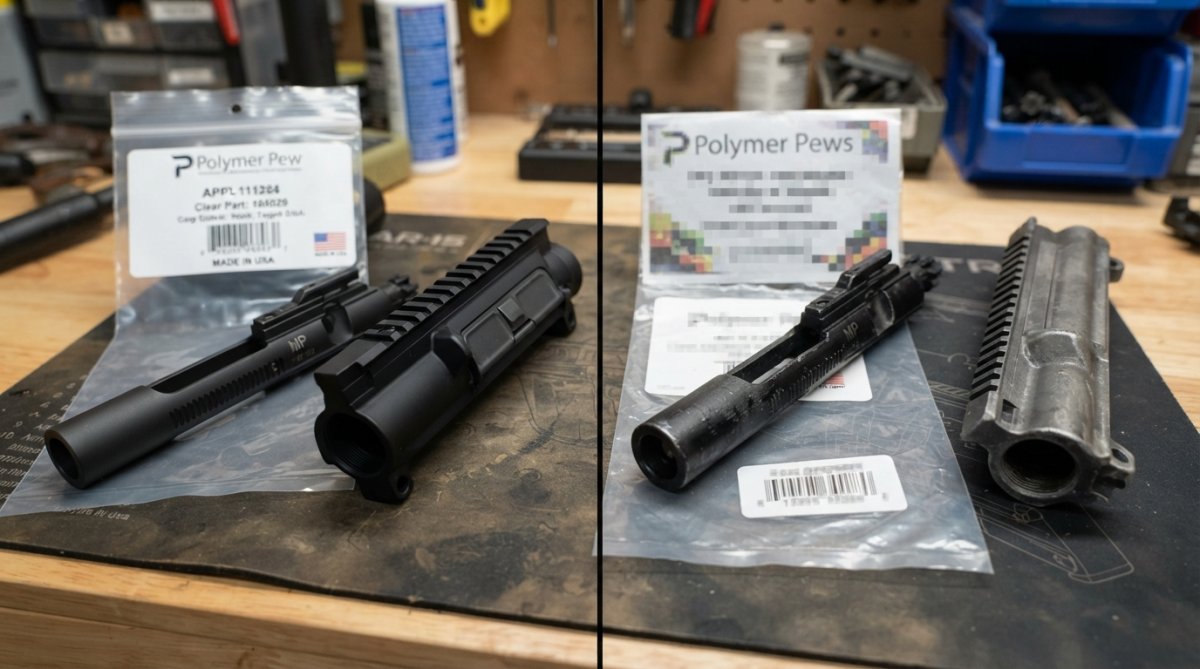
Authentic manufacturers maintain consistent packaging standards and precise markings. Counterfeit parts often arrive in generic boxes with blurry printing, misspelled brand names, or inconsistent logos. Check the font consistency on markings, authentic mil-spec stamps use uniform depth and spacing. Counterfeit stamps often appear shallow, uneven, or misaligned.
Dimensional Accuracy and Fit Inspection
Counterfeit parts frequently fail dimensional accuracy checks. A lower receiver that doesn’t accept a standard upper receiver smoothly indicates dimensional problems. Test fit components before committing to full assembly. Quality parts slide together with slight resistance, proper tolerance stacking, not binding.
Testing Firearm Components for Safety
Before trusting new components in your platform, verify they meet safety standards through practical testing.
Pressure Testing and Heat Treatment Verification
Pressure testing reveals whether components can handle the recoil impulse safely. Quality manufacturers conduct pressure testing during production and document results. Request test data from your supplier, legitimate manufacturers provide this information readily.
Cycling Reliability and Function Testing
Chamber a round and cycle the action manually. Components should move smoothly without binding or hesitation. A quality bolt carrier group cycles with consistent resistance, not too tight, not too loose. Counterfeit parts often show binding or rough cycling that indicates dimensional problems or poor surface finish.
Compatibility Verification Protocols
Compatibility failures waste time and money. Verify compatibility before assembly to prevent frustration and potential damage.
Tolerance Stacking and Fit Tolerance
Tolerance stacking occurs when multiple parts with loose individual tolerances combine to create unacceptable overall fit. A lower receiver that’s slightly oversized combined with an upper receiver that’s slightly undersized creates binding that prevents proper cycling. Budget manufacturers sometimes maintain looser individual tolerances, increasing stacking risk.
Drop-In Kit Compatibility Testing
Drop-in kits claim to install without modification, but compatibility still requires verification. Test fit all components before final assembly. A quality drop-in trigger should slide into place without forcing. If you’re applying pressure to install components, something isn’t right.
Material Quality and Manufacturing Standards
Material selection and manufacturing processes determine whether budget parts actually perform reliably or simply fail quietly.
Mil-Spec vs. Commercial Grade
Mil-spec components meet military specifications for material composition, heat treatment, and dimensional accuracy. Commercial grade components follow looser standards, though reputable manufacturers maintain quality standards exceeding commercial minimums. Budget components sometimes claim mil-spec compliance without actual testing or documentation.
Surface Finish and Nitride Treatment
Nitride finish protects steel from corrosion and wear. Proper nitride treatment creates a surface layer that’s significantly harder than the underlying steel. The finish should be uniform in color and thickness. Counterfeit or budget components sometimes show uneven finish or inadequate thickness.
Maintenance Requirements for Budget Parts
Budget components often demand more maintenance attention than premium alternatives. Understanding these requirements prevents premature failure.
Preventative Maintenance Schedules
Budget bolt carrier groups require more frequent cleaning than quality alternatives. Looser tolerances allow more fouling accumulation, which accelerates wear. Plan on cleaning every 500-750 rounds instead of the 1000+ round intervals that quality components tolerate.
Long-Term Durability and Component Longevity
Budget components rarely last as long as quality alternatives. A budget bolt carrier group might provide reliable service for 3,000-5,000 rounds before showing wear. Quality components often exceed 10,000 rounds with minimal degradation. The cost per round of use often favors quality components despite higher initial price.
| Component Type | Budget Tolerance | Quality Benefit | Maintenance Frequency |
|---|---|---|---|
| Bolt Carrier Group | Loose tolerances, higher fouling | Tighter tolerances, less wear | Every 500-750 rounds |
| Lower Receiver | Dimensional variance | Mil-spec accuracy, compatibility | Annual inspection |
| Trigger Assembly | Variable pull weight | Consistent feel, reliability | Every 1000 rounds |
| Handguard | Acceptable | Aesthetic only | As needed |
| Gas System | Loose tuning | Optimized cycling, longevity | Every 2000 rounds |
Frequently Asked Questions
Which firearm parts should you never buy cheap?
Critical failure points, bolt carrier groups, firing pins, and springs, demand quality because they directly affect safety and cycling reliability. Budget options here create pressure testing failures and thermal stability issues. Non-critical parts like handguards, rail systems, and muzzle devices tolerate budget builds better. The rule: spend on components that contain high-pressure impulse or control recoil; save on ergonomic add-ons. Your bolt carrier group and buffer system determine whether your build cycles reliably under sustained fire.
How can you verify the quality of budget-friendly firearm components?
Request documentation of heat treatment and pressure testing from the manufacturer. Check for mil-spec markings and dimensional accuracy using precision calipers. Inspect surface finish, nitride coating should be uniform and dark, not patchy or thin. Test cycling reliability with dummy rounds before live fire. Verify tolerance stacking by dry-fitting components to identify binding. Purchase from vendors who provide test results and accept returns if components fail function tests.
What is the ‘buy once, cry once’ rule in firearm customization?
This philosophy means investing in quality components upfront to avoid repeated failures and replacement costs. A $150 trigger with consistent pull weight and proven reliability costs less over time than replacing three $40 triggers that fail or vary wildly. Applied to budget builds, it means identifying which parts justify higher spending (bolt carrier groups, triggers, springs) and which can safely use economy options (rails, grips, handguards). The rule doesn’t mean buy premium everything, it means buy once on critical parts and cry once on non-essential upgrades where budget options work.
How do you know if a firearm part is compatible with your build?
Verify dimensional accuracy by cross-referencing published specifications against your platform’s measurements. Test fit components before assembly, drop-in kits should require zero modification. Check tolerance stacking by dry-cycling with dummy rounds to identify binding or sluggish operation. Confirm mil-spec compliance for critical parts; non-compliant components create pressure testing failures. Consult platform-specific forums and compatibility matrices from reputable manufacturers. Request compatibility verification from the vendor before purchase. Never assume ‘universal’ parts fit without physical verification.