Table of Contents
- Single Stage vs Two Stage Trigger: Quick Comparison Table
- What Is a Single-Stage Trigger and How Does It Work?
- What Is a Two-Stage Trigger and How Does It Work?
- Trigger Pull Weight Explained: Weight vs. Quality
- How to Install an AR-15 Trigger: Drop-In vs. Standard
- Best Drop-In AR-15 Triggers: Single vs Two Stage Picks
- Mechanical Safety, Maintenance, and Buffer System Integration
- Which Trigger Should You Pick for Your Build?
- Frequently Asked Questions
Last Updated: September 12, 2026
Single Stage vs Two Stage Trigger: Quick Comparison Table
The single stage vs two stage trigger AR-15 explained debate comes down to one question: do you want the shot to break the moment you press, or after a short, deliberate take-up? Here’s the short version before the deep dive.
A single-stage trigger releases the hammer as soon as you apply pressure (saami.org). A two-stage trigger requires you to take up slack first, hit a defined wall, then press through a crisp break. Neither is objectively better, they solve different problems.
| Feature | Single-Stage | Two-Stage |
|---|---|---|
| Pull feel | One continuous press | Take-up, wall, then break |
| Typical pull weight | 3.5-4.5 lbs | 4.0-4.5 lbs total |
| Reset | Very short | Slightly longer |
| Best for | Rapid fire, tactical, follow-up shots | Precision, bench rest, duty use |
| Learning curve | Low | Moderate |
| Safety margin | Smaller | Larger, thanks to take-up |
That table covers the headline differences, but the mechanics matter more than the spec sheet. Below: how each trigger works, how to install one, and which type fits your build.
What Is a Single-Stage Trigger and How Does It Work?
A single-stage trigger is a fire control group that releases the hammer through one uninterrupted range of motion. No take-up, no wall, no transition: you press, sear engagement releases, and the hammer falls.
The geometry is simple: the sear surface holds the hammer under spring tension until trigger movement forces the sears to disengage. With no first stage to absorb slack, the break arrives almost immediately after you start your press, which is why competitive shooters chasing fast split times gravitate toward this design.
The trade-off is margin. With no take-up, there’s less room for error between “finger on trigger” and “hammer release.” A light single-stage can feel unforgiving to a new shooter, and without a defined wall you rely entirely on trigger control to avoid a premature shot.
A common mistake is dropping a 3.5 lb single-stage trigger into a rifle without checking sear engagement. If the sears aren’t properly mated, you can end up with a trigger that feels fine on the bench but doubles or fails to reset under recoil. Always function-test with dummy rounds before live fire.
What Is a Two-Stage Trigger and How Does It Work?
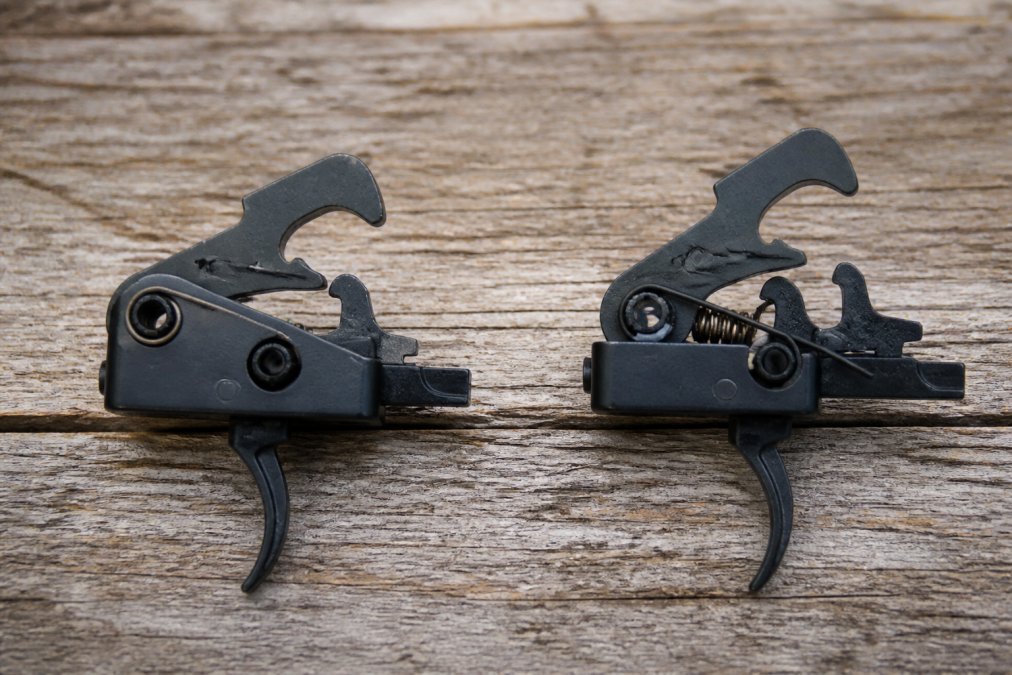
A two-stage trigger splits the pull into two phases: a light first stage that takes up slack, and a heavier second stage that breaks the shot, with a clear wall between them. What most guides skip is the geometry that makes the wall exist.
Inside a two-stage group, the trigger and hammer sears sit in partial engagement at rest. The first stage is the trigger rotating through that slack until the sear surfaces meet at full contact, that meeting point is the wall. The second stage is a short, direct press that rotates the sear out of engagement and lets the hammer fall. The disconnector catches the hammer on the way back, so the trigger must be released past reset before it can fire again.
That first stage does real work. Because it moves the sear surfaces into near-contact, the second stage needs only a short, consistent press. Total sear travel in the final phase is smaller than on a single-stage, so the break feels crisper and more repeatable at the same pull weight. A 4.5 lb two-stage often feels lighter than a 4.5 lb single-stage because most of that weight is spent in the first stage, where nothing is released (nra.org).
For precision shooting, the wall acts as a built-in staging point: prep the trigger under recoil, hold at the wall, and break the shot the instant your sights settle. Bench rest and long-range shooters lean on this because it separates the decision to fire from the mechanics of firing. The take-up also confirms tactilely that your finger is on the trigger and the safety is off, a real margin in cold-weather or gloved shooting.
The cost is speed: that first-stage take-up adds travel on every shot, which is why two-stage triggers rarely win pure speed drills. It also adds parts, more sear surfaces to cut, mate, and time than a single-stage, which is where both its precision advantage and its maintenance burden come from.
If you’re tuning a two-stage, resist the urge to shorten the first stage to nothing. The take-up is what lets the second stage stay short and crisp. A two-stage with a hair-trigger first stage is just a single-stage with extra parts.
Trigger Pull Weight Explained: Weight vs. Quality
Trigger pull weight is the measured force required to release the hammer, but weight alone tells you little about how a trigger feels. A 4.5 lb two-stage with clean sear engagement will often outshoot a 3.5 lb single-stage with a gritty, inconsistent break.
Pull quality comes down to three things: creep (perceptible sear movement before the break), over-travel (how far the trigger continues past the break), and consistency (whether pull weight holds steady shot to shot or drifts as sears wear).
A match grade trigger controls all three; a budget trigger controls none well. That’s the real difference between a $130 drop-in and a $245 precision unit, and it matters more than the number on the box.
| Pull Weight | Typical Use | Feel |
|---|---|---|
| 2.5-3.0 lbs | Competition, bench rest | Very light, requires discipline |
| 3.5-4.0 lbs | General range, hunting | Balanced |
| 4.0-4.5 lbs | Duty, defensive | Heavier, safer margin |
| 5.0+ lbs | Mil-spec, hard use | Heavy, deliberate |
Coming from a factory mil-spec trigger, expect any of these to feel like a different rifle. Trigger pull weight is a preference, not a spec: pick the weight that matches your discipline, then focus on break quality.
How to Install an AR-15 Trigger: Drop-In vs. Standard
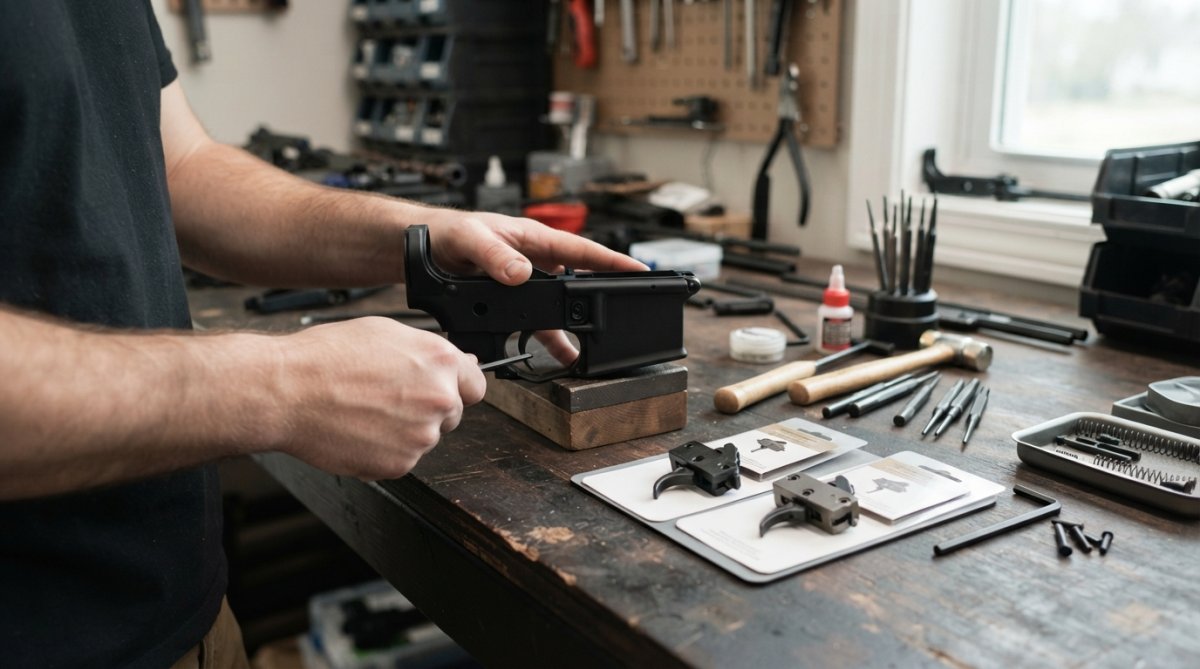
Installing an AR-15 trigger comes down to two paths: a drop-in module that seats as one unit, or a standard trigger group you assemble pin by pin. Drop-in kits are faster and the route most DIY builders choose.
Here’s the practical process for a drop-in install:
- Clear the rifle and separate the upper from the lower receiver.
- Remove the safety selector and old trigger pins.
- Lift out the original trigger and hammer assembly.
- Seat the drop-in module into the fire control pocket.
- Reinstall the safety selector and secure the anti-walk pins.
- Function-test: safety on, safety off, reset, and hammer drop.
Standard installs follow the same logic but add spring placement and disconnector timing. Budget extra time if you’ve never done one, and never force a pin.
Drop-in kits fail to seat for one reason nine times out of ten: out-of-spec lower receivers. Before you blame the trigger, check your lower’s fire control pocket dimensions. A quality drop-in will fit a mil-spec lower without modification, but clone lowers vary, and that variance is where binding issues start.
Best Drop-In AR-15 Triggers: Single vs Two Stage Picks
The best drop-in AR-15 triggers balance break quality, reset, and price. Here are five worth your money, with honest notes on where each wins and where it doesn’t.
Polymer Pew Drop-In Kits are our budget-friendly option for builders who want a real upgrade without a premium price tag. Anodized aluminum housings and stainless steel internals hold up to hard use, and the kits are tested for compatibility with common clone lowers.
Rise Armament RA-140 Super Sporting Trigger is the value pick for single-stage fans: a consistent 3.5 lb pull, heat-treated steel components, and anti-walk pins included. The short reset makes follow-up shots fast, but there’s no take-up buffer, so it rewards good trigger discipline.
Geissele Automatics SSA is the benchmark two-stage trigger: a distinct wall, roughly 4.5 lbs total pull, and non-adjustable sear engagement for consistent safety. It’s the pick for duty and precision use, though it’s the highest-priced option here.
TriggerTech AR-15 Adaptable Trigger uses Frictionless Release Technology for a creep-free break, with pull weight adjustable from 2.5 to 5.0 lbs. Competitive shooters love the tuning range. It needs periodic cleaning to keep the internals consistent. Maintaining this level of precision requires a disciplined approach to cleaning tactical gear to ensure that debris does not interfere with the delicate internal components.
CMC Triggers Single Stage Drop-In is the classic glass-break single-stage. 8620 alloy and S7 tool steel construction, factory-tuned around 3.5 lbs. Reliable and clean. The fixed weight won’t suit everyone.
| Trigger | Type | Pull Weight | Best For |
|---|---|---|---|
| Polymer Pew Drop-In | Single | Varies | Budget builds, clone compatibility |
| Rise Armament RA-140 | Single | 3.5 lbs | Fast follow-up shots |
| Geissele SSA | Two-stage | ~4.5 lbs | Duty, precision |
| TriggerTech Adaptable | Single | 2.5-5.0 lbs | Competition tuning |
| CMC Single Stage | Single | ~3.5 lbs | General purpose |
Mechanical Safety, Maintenance, and Buffer System Integration
Most trigger guides stop at feel. The three things that actually decide whether a trigger is safe, durable, and consistent over thousands of rounds are sear geometry, wear patterns, and how the trigger interacts with the recoil system.
Drop safety comes from geometry, not pull weight. A drop-safe AR-15 trigger relies on the sear engagement angle and the disconnector’s hook to hold the hammer if the rifle is dropped or the trigger is struck. On a properly cut sear, the engagement surface is angled so force on the hammer pushes the sears deeper into contact rather than sliding them apart. A 3.5 lb single-stage with correct geometry is drop-safe, but a trigger with a shallow or incorrectly angled sear can pass a bench function check and still fail a drop test (saami.org). Function-test with dummy rounds and, if unsure, do a controlled drop test on a padded surface with the chamber empty. Never modify sear surfaces by hand, you change the engagement angle and can turn a safe trigger into an unsafe one.
Maintenance and longevity differ by design. A single-stage group has fewer sear surfaces and parts, so there’s less to wear and less to go out of time. A two-stage group has more engagement surfaces and a disconnector that must time correctly with the sear, making it more sensitive to grit, dried lubricant, and spring fatigue. Single-stage triggers hold pull weight longer with minimal attention; two-stage triggers reward regular cleaning of the fire control pocket and inspection of sear engagement whenever you swap springs or buffers. Over-lubricating sear surfaces attracts grit that accelerates wear, a light film is enough.
Buffer system integration is the angle almost nobody covers. The trigger doesn’t cycle the bolt, but it must reset before the bolt returns to battery or you get a dead trigger on the next shot. A heavier buffer and stronger action spring slow the bolt’s rearward travel and give the trigger more time to reset. A lightweight bolt carrier with a light trigger and light buffer can outrun the reset, the trigger hasn’t re-engaged the disconnector before the bolt is back in battery, and the next press does nothing. The fix isn’t a new trigger; it’s matching buffer weight to your gas system, ammo, and bolt carrier. If you’re chasing fast split times, tune the recoil system first, then the trigger.
A trigger that doubles, fails to reset, or goes dead under recoil is almost never a trigger problem alone. Check sear engagement, disconnector timing, and buffer weight together. Swapping the trigger without addressing the recoil system usually just moves the symptom.
Pull weight is a number. Pull quality, sear engagement, drop safety geometry, and reset consistency are what actually decide whether a trigger performs. Judge a trigger on break quality, safety, and reliability first, weight second.
Which Trigger Should You Pick for Your Build?
Pick a single-stage trigger if you shoot fast, run drills, or want the shortest possible reset. Pick a two-stage trigger if you shoot for precision, want a deliberate wall before the break, or need a larger safety margin for duty use.
The build should drive the decision. A lightweight carbine for close-quarters work pairs naturally with a single-stage; a precision rifle with a magnified optic and heavier buffer rewards a two-stage. If you’re building a clone on a budget, a drop-in single-stage from Polymer Pew gets you a real upgrade without premium pricing, and the kits are tested for variant compatibility so you’re not fighting binding issues out of the box.
Pull weight and pull quality are not the same purchase. Spend your money on break quality and consistency, then tune weight to taste, that’s the difference between a trigger you tolerate and one you trust.
Choosing the right trigger is a question of what you’re asking your rifle to do, and getting it wrong means fighting your own equipment every range session. Polymer Pew builds drop-in kits with anodized aluminum housings and stainless steel internals, tested for compatibility with the clone lowers most builders actually run. If you want a trigger that seats clean, resets hard, and holds consistent pull weight without a premium price tag, start with our drop-in options. Get your Flatties here!!!
Frequently Asked Questions
Is a single stage or double stage AR trigger better?
Neither is universally better. A single-stage trigger breaks immediately with no take-up, which suits rapid follow-up shots and general-purpose builds. A two-stage trigger has a light first stage that lets you prep the shot before a crisp break, which helps precision shooting. The right pick depends on whether you value speed or a deliberate, predictable break more in your single stage vs two stage trigger decision.
Is a 2 stage trigger worth it?
For precision work, yes. The take-up stage lets you marry up to the break point before the shot, so the final pull is short and consistent. For fast tactical shooting or plinking, a single-stage trigger often feels faster because there is no extra travel. If you mostly shoot from a bench rest or hunt at distance, a two-stage trigger is usually worth the cost.
Are two stage triggers legal for civilian use?
Yes. A two-stage trigger is a standard fire control group and is legal for civilian use under federal law. It does not change the rifle’s semiautomatic function. Some states have their own rules on certain trigger accessories, so check your state and local laws before buying if you are unsure. The trigger type itself is not a restricted item.
How does trigger pull weight differ between single and two stage models?
Single-stage triggers typically run around 3.5 to 5 pounds total, all in one continuous pull. Two-stage triggers split the weight: a light first stage of roughly 2 to 2.5 pounds, then a second stage of about 2 to 3 pounds, for a total near 4.5 pounds. The split lets you stage the trigger before the break, which is why trigger pull weight explained alone does not tell the whole story about feel.
Can I install a two stage trigger in a standard mil-spec lower receiver?
Most two-stage triggers fit standard mil-spec lowers, but check the manufacturer’s compatibility notes first. Drop-in models are the easiest option since they come as a self-contained module and use anti-walk pins. Standard pin-and-spring installs need the right slave pin and a bit more patience. If you have never done one, follow the maker’s instructions and test function with a dummy round before live fire.