Last Updated: November 14, 2026
Quick Summary
A 45-degree safety selector covers half the distance of a 90-degree selector, so it switches between safe and fire with less hand movement. The 90-degree throw is the traditional choice with the widest compatibility. Confirm fit with your lower receiver and trigger before buying either type of safety selector.
- A 90-degree selector rotates a full quarter turn, while a 45-degree selector covers half that distance.
- Shorter throw means less wrist and hand travel when switching between safe and fire modes.
- The 90-degree throw is the more familiar option and is easier to match to the rest of the platform.
- Check compatibility with your lower receiver and trigger group before you buy any selector.
- Perform a function check with an unloaded rifle after every selector installation.
Table of Contents
- What 45-Degree and 90-Degree Selector Throw Actually Means
- Side-by-Side Comparison: Throw, Ergonomics and Compatibility
- Short Throw Safety Selector AR15 Pros and Cons
- Traditional 90-Degree Selectors: Where They Still Win
- Best 45 Degree Safety Selector Options and What to Check Before You Buy
- Where a 60 Degree Safety Selector Fits Between the Two
- Choosing Your Selector: Next Steps for Your Build
- Frequently Asked Questions
What 45-Degree and 90-Degree Selector Throw Actually Means
Throw is the distance a safety selector travels between safe and fire. A 90-degree selector rotates a quarter turn, while a 45-degree selector covers half that distance. Shorter throw means less wrist movement to change modes, which is why the choice matters during fast, repeated manipulation.
Throw is set by the selector’s geometry and how it engages the fire control group, so the number on the box describes movement, not safety performance.
Side-by-Side Comparison: Throw, Ergonomics and Compatibility
Here is how the two throws compare on the factors that usually decide the choice.
| Factor | 45-Degree (Short Throw) | 90-Degree (Full Throw) |
|---|---|---|
| Rotation distance | Half a quarter turn | Full quarter turn |
| Switching speed | Faster, less hand travel | Slower, more deliberate |
| Lever reach | Shorter arc, less grip change | Longer arc, familiar feel |
| Trigger finger interaction | Can sit closer to trigger guard | Wider clearance needed |
| Compatibility | Check trigger and hammer geometry | Widest fit across builds |
| Indicator visibility | Mark placement varies by model | Standard mil-spec marking |
Compatibility is worth checking carefully. Confirm that any selector is designed for your lower receiver and fire control group before you buy.
Installation follows the same basic sequence for both throws: remove the grip, capture the safety detent and spring, rotate the selector to align the shaft with the receiver, and reinstall the grip to retain the detent. For a full walkthrough with tools, compatibility checks, and function verification, see step-by-step installation guide. If the detent does not click cleanly into both safe and fire, stop and recheck the parts rather than forcing the lever.
Watch out: after any selector install, perform a function check with an unloaded rifle before use.
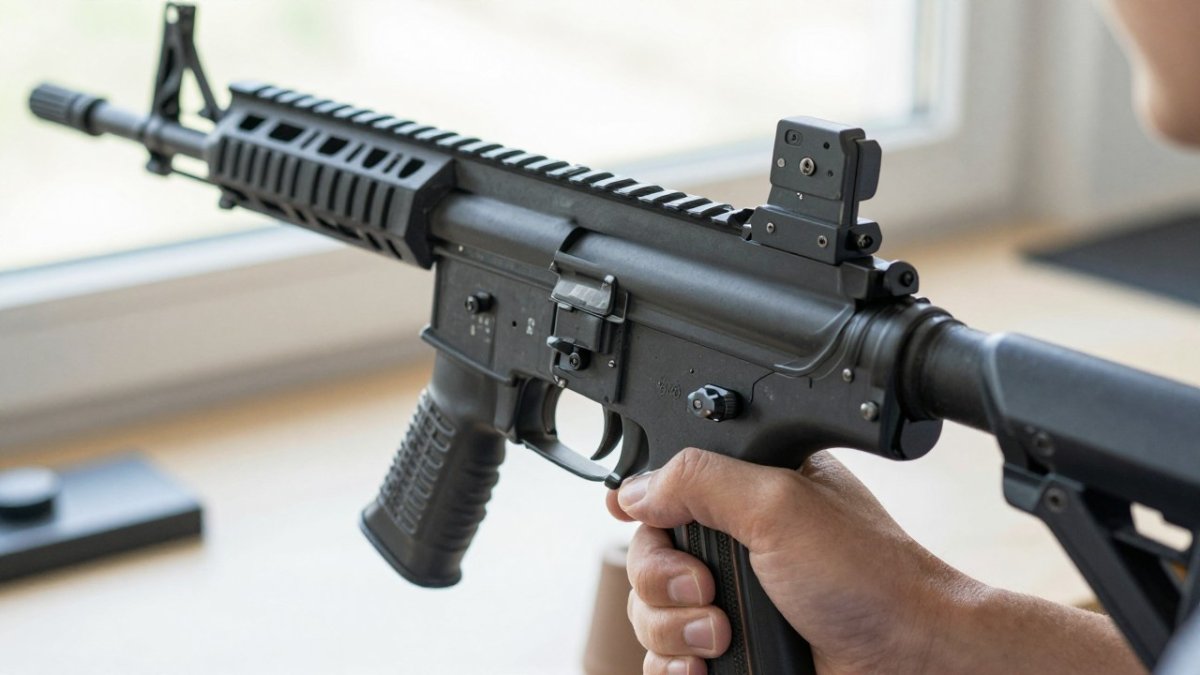
Indicator readability deserves its own check. With a 90-degree selector, the lever typically points to markings at roughly the 9 o’clock and 12 o’clock positions on the receiver. A 45-degree selector moves the lever through a shorter arc, so some models place the markings closer together or use a different lever shape to keep the safe and fire positions visually distinct. Before you commit, look at how the lever aligns with the markings on your specific lower, not just the product photos.
Short Throw Safety Selector AR15 Pros and Cons
A short throw safety selector AR15 setup rewards shooters who manipulate the safety often or want minimal hand movement. The main advantage is speed and a smaller motion envelope, but whether that translates into a better experience depends on your hand size, grip, and how you run the rifle.
Pros:
- Faster transition between safe and fire because the lever travels half the distance
- Less wrist and hand travel, which matters when you are switching modes without breaking your grip
- Useful for shooters with smaller hands or shorter fingers who have trouble reaching a full 90-degree lever without shifting their hand
- Can keep the thumb or trigger finger closer to its next position, which some shooters find helpful in competition or fast-paced drills
Cons:
- Some shooters find the shorter arc feels rushed or harder to feel as a distinct position, especially with gloves
- Compatibility with trigger geometry should be verified; a short-throw selector may not provide the same tactile feedback with every trigger group
- A minority of users report they prefer the traditional throw for transitions and sweeping, particularly when the lever is swept rather than pressed
One forum participant said 45 degrees felt too short for typical safety-trigger geometry. If binding is a concern, learn what causes super safety binding and how to fix it. That is one opinion, not a tested result, so treat it as a reason to check fit rather than a verdict.
A practical way to decide is to match the throw to your hand and grip. Hand size and grip style affect which throw feels more natural, so it is worth comparing the two in hand. If you shoot with gloves, try to handle both throws before buying; the shorter arc can feel less distinct through thick material.
Use case matters too. For competition or fast-paced shooting where the safety is manipulated constantly, a short throw can reduce wasted motion. For general-purpose or defensive use where the safety may be manipulated under stress, some shooters prefer the more deliberate 90-degree feel because it is harder to move accidentally. Neither choice is universally better; the goal is a selector you can operate positively without looking.
Traditional 90-Degree Selectors: Where They Still Win
The 90-degree throw is the traditional choice, and it still makes sense for many builds. Its longer arc gives a clear, deliberate feel between positions, and it is the most familiar setup for shooters who learned on standard rifles. That familiar, deliberate feel is one part of a rifle’s overall setup, just as chassis for precision rifle builds shape how a precision platform fits and handles.
A 90-degree selector is often the simpler choice when you are unsure about compatibility, because it matches the original design the rest of the platform was built around.
Best 45 Degree Safety Selector Options and What to Check Before You Buy
If you want a 45-degree option, compare products from the manufacturers’ own sites, checking each one’s stated compatibility and current pricing.
Before buying any best 45 degree safety selector, check these points:
- Confirm the selector fits your lower receiver and fire control group
- Check that the lever clears your trigger finger and grip
- Verify the safe and fire markings are readable and line up with the lever
- Read the manufacturer’s installation and function-check instructions
Poly Pew carries a range of drop-in components and safety kits. Pricing depends on the specific part and order, so check the Poly Pew website for current prices and availability before you order.
Where a 60 Degree Safety Selector Fits Between the Two
A 60-degree safety selector sits between the two standard throws. It offers more movement than a 45-degree option while still being shorter than the traditional 90-degree arc. Some shooters look at intermediate throws when neither standard option feels right.
The trade-off is that intermediate throws are less common, so you will have fewer options and less community experience to draw on. Compatibility checks matter just as much here as with the other two throws.
Choosing Your Selector: Next Steps for Your Build
Start with how you will use the rifle. If you manipulate the safety often and want the quickest transition, a 45-degree selector is worth trying. If you want the familiar feel and the widest compatibility, a 90-degree selector is the safer pick.
Before you order, confirm compatibility with your lower receiver and trigger. Once you have a selector, a step-by-step installation guide will walk you through tools and function checks. If you are still choosing parts, compare curved and flat triggers as well, since trigger geometry affects how a selector feels in use.
Frequently Asked Questions
What is the difference between a 45-degree and 90-degree AR-15 safety selector?
A 45-degree selector rotates about half as far between safe and fire as a standard 90-degree selector, so the lever moves a shorter distance. Some selectors can be configured for either throw, which lets you test which feels better. The 90-degree design is the traditional mil-spec feel most shooters learned on. Neither throw is inherently safer. The choice comes down to how your hand moves on the grip and how quickly you want to switch between safe and fire. Check that any selector you buy functions correctly with your trigger and lower before relying on it.
Is a 45-degree safety selector better than a 90-degree selector?
Not for everyone. Shooters who want faster, shorter movement often consider a 45-degree selector. Others prefer the position changes of a 90-degree selector. The practical approach is to handle both throws if you can, then choose the one that feels reliable with your grip and trigger.
Is an ambidextrous AR-15 safety selector worth it?
For shooters who operate the rifle from both shoulders or who need to manipulate the selector with either hand, an ambidextrous selector can be worth the added cost. Pricing and availability can change, so check each manufacturer’s site for current prices. Confirm the lever fits your lower and trigger before committing.
Are 45-degree AR-15 safety selectors compatible with standard lowers?
Many 45-degree selectors are designed for standard AR-15 lower receivers, but compatibility depends on the specific model and installation. Some selectors are marketed for more than one platform, while others are specific to one design. Before buying, confirm the product’s stated compatibility, check that the lever clears the trigger guard and grip, and perform a function check to verify the selector moves fully between safe and fire without binding.