Last Updated: November 5, 2026
Quick Summary
Choose pistol sights by matching the type to how you actually shoot: night sights or a micro red dot for concealed carry and low light, fiber-optic front sights for daylight range and action shooting, and adjustable irons or a full-size red dot for precision work. Shoot a few hundred rounds with the factory setup first, then confirm your slide’s optic footprint before buying.
- Pistol sight types fall into five families: standard iron, fiber-optic, night sights, red dot optics, and lasers.
- Fiber-optic front sights are fast in daylight but go dark in low light because there is no light to gather.
- Night sights use tritium inserts that glow for years without batteries but dim over time.
- Confirm your slide’s optic footprint before buying a red dot so it does not sit high or fail to zero.
- Use a proper sight pusher rather than a punch and hammer, and re-confirm zero after installation.
Table of Contents
- Start With How You Actually Shoot
- Pistol Sight Types: A Practical Breakdown
- Iron Sights vs Red Dot Sights: The Real Trade-Offs
- How to Choose a Pistol Red Dot That Fits Your Slide
- Pistol Sight Alignment and Sight Picture Basics
- Fixed vs Adjustable Sights, Sight Height, and Installation
- Match Your Sights to Your Poly Pew Build
- Frequently Asked Questions
Start With How You Actually Shoot
The right pistol sights start with an honest look at how you train, not with a spec sheet.
Start by answering three questions about your shooting. How often do you train? What distance do you shoot at most? Do you shoot with both eyes open or one eye squinted?
A common mistake is buying sights before shooting the gun as built. Put a few hundred rounds through your pistol with the factory setup first.
If you want to see how sights fit into a broader accuracy plan, our breakdown of affordable pistol accuracy mods shows where sight upgrades land in the priority order.
Pistol Sight Types: A Practical Breakdown
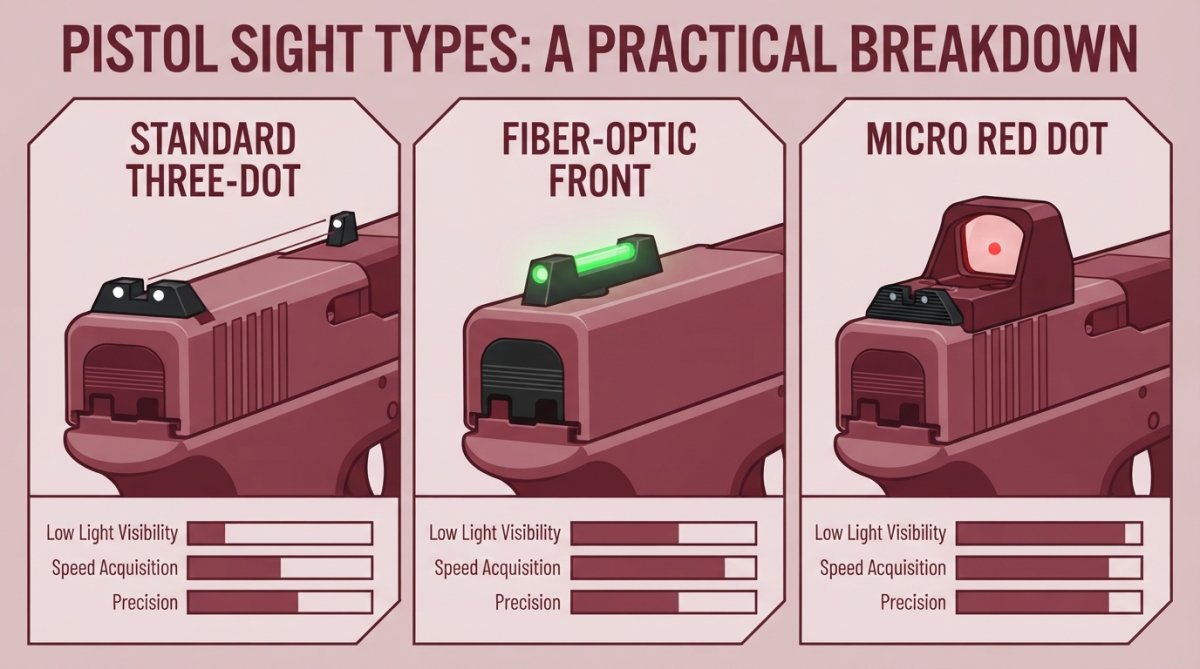
Pistol sight types fall into five families: standard iron sights, fiber-optic sights, night sights, red dot optics, and lasers. Each solves a different problem, and most shooters only need one or two of them. The useful question is not which type is best but which type fits your use case, lighting, experience, and budget. The breakdown below maps each family to those four variables so you can narrow the field before you spend money.
Standard Iron Sights and Fiber-Optic Sights
Standard iron sights are the factory baseline: a front post and a rear notch, often with white dots for contrast. They cost nothing extra, they are rugged, and they work in most daylight conditions. Their weakness is low contrast against dark targets or in shadow.
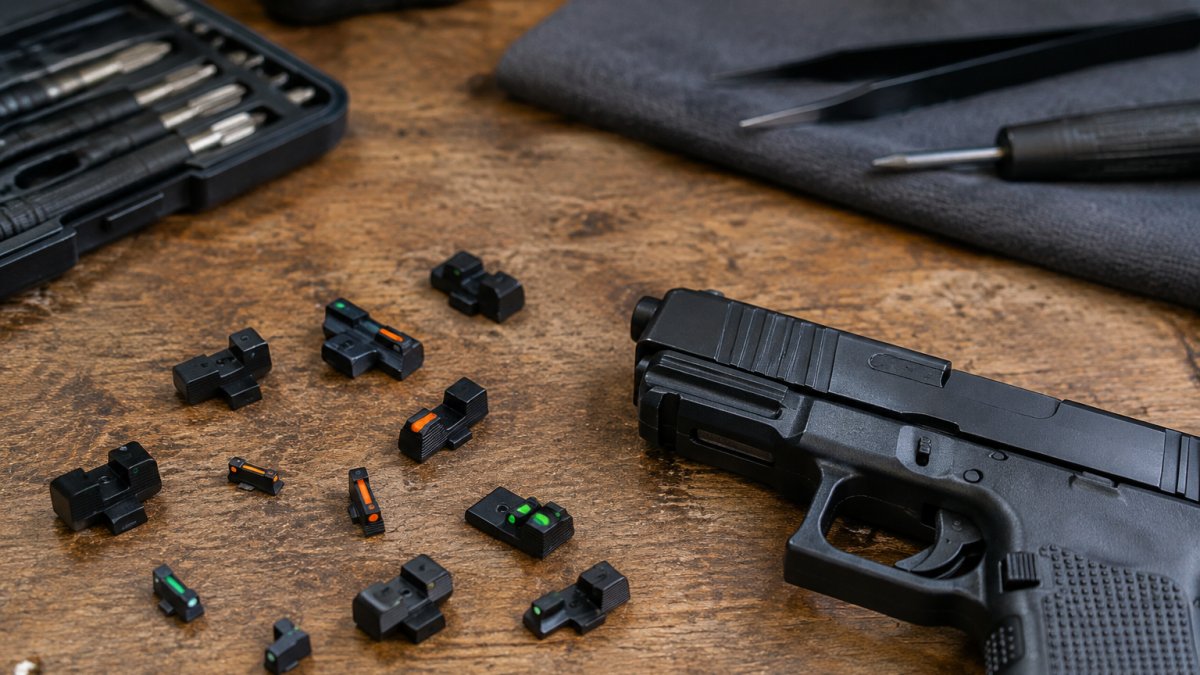
Fiber-optic sights replace the front blade with a light-gathering rod. The rod collects ambient light and glows bright green or red, which pulls your eye to the front post fast. For daylight range work and action shooting, fiber-optic front sights are hard to beat for speed.
Night Sights and Laser Sights
Night sights use tritium inserts that glow on their own for years without batteries. They give you a visible sight picture in near-total darkness. The trade-off is a softer glow that can wash out against a bright flashlight or headlights. Tritium has a finite half-life, so the glow dims over time and the inserts eventually need replacement.
Laser sights project a dot on the target, which helps with point shooting and dry fire practice. They add bulk, need batteries, and can teach bad habits if you rely on the dot instead of your grip and trigger control.
Match the Sight to Your Use Case
Use this decision framework to narrow the field before you buy:
- Concealed carry, close range, low light: night sights or a micro red dot with backup irons. Prioritize a low profile that clears the holster and does not snag.
- Daylight range and action shooting: fiber-optic front with a plain rear. Prioritize speed of front-sight pickup.
- Home defense, mixed lighting: night sights or a red dot with a bright setting and backup irons. Prioritize visibility in both dark and flashlight-lit conditions.
- Precision and distance work: adjustable iron sights or a full-size red dot with a fine reticle. Prioritize a repeatable zero and a clear sight picture.
- New shooter on a budget: factory iron sights first, then upgrade once you know your eyes and your hold.
Cost of Ownership, Not Just Purchase Price
The sticker price is only part of the cost. Iron sights are the cheapest to own because they need no batteries and no mounting hardware. Fiber-optic sights add the cost of replacement rods. Night sights add the eventual cost of tritium replacement. Red dots add mounting plates, batteries, and the cost of training to find the dot under stress. Lasers add batteries and mounting hardware. Budget for the whole system, not just the sight.
For a deeper comparison of low-light options, our review of durable pistol sights for low light breaks down tritium, fiber optic, and hybrid designs with real specs.
Iron Sights vs Red Dot Sights: The Real Trade-Offs
Iron sights vs red dot sights comes down to one question: do you want to train a new skill or keep an old one? Iron sights reward front-sight focus and cost nothing. Red dots reward target focus and both-eyes-open shooting, but they require practice to find the dot under stress.
| Factor | Iron Sights | Red Dot Sights |
|---|---|---|
| Cost | Low | Higher |
| Battery | None | Needs replacement |
| Learning curve | Familiar | Needs retraining |
| Low-light use | Depends on inserts | Good with brightness control |
| Durability risk | Minimal | Glass can crack |
The dot does not make you accurate by itself. New red dot shooters often hunt for the dot instead of presenting the gun consistently. That is a training problem, not an optic problem.
How to Choose a Pistol Red Dot That Fits Your Slide
Choosing a pistol red dot starts with your slide’s optic footprint, not the reticle. A red dot that does not match your cut or adapter plate will sit high, wobble, or fail to zero.
Micro red dots suit concealed carry because they sit low and add little width. Full-size optics give a bigger window for duty and competition use.
Watch out: mounting an optic on the wrong plate or over-torquing the screws strips threads and sends your zero wandering. Use the manufacturer’s torque spec and a thread-locking compound.
Pistol Sight Alignment and Sight Picture Basics
Pistol sight alignment means centering the front post in the rear notch with equal height and equal light on both sides. Sight picture adds the target: the aligned sights sit on the spot you want to hit.
With iron sights, your eye focuses on the front sight, and the target stays slightly blurry. With a red dot, your eye focuses on the target and the dot floats over it.
Dry fire builds this faster than live ammo. Practice presenting the gun until the sights line up without conscious thought. Consistent sight picture beats raw speed every time.
Fixed vs Adjustable Sights, Sight Height, and Installation
Fixed sights are set at the factory and stay put. Adjustable sights let you dial windage and elevation for different loads or distances. For a defensive handgun, fixed sights are simpler and less to break. For precision work, adjustable sights earn their keep. The bigger decision is not fixed versus adjustable but whether the sight will actually fit your slide, your holster, and your zero, and that is where most builds go wrong.
Sight Height and Point of Impact
Sight height affects point of impact. A taller front sight lowers your shot, and a shorter one raises it. Match the rear and front as a set, and check that the sights clear your holster without snagging. If you change ammunition weight or velocity, re-confirm your zero; a load change can shift point of impact even with the same sights.
Compatibility: Footprint, Slide Cuts, and Mounting Plates
Before buying a red dot, confirm your slide’s optic footprint. A red dot that does not match your cut or adapter plate will sit high, wobble, or fail to zero. Many slides ship with a specific footprint cut, and aftermarket plates adapt one footprint to another. Check three things: the slide cut pattern, the optic’s footprint, and whether a mounting plate is required.
Watch out: mounting an optic on the wrong plate or over-torquing the screws strips threads and sends your zero wandering. Use the manufacturer’s torque spec and a thread-locking compound, and re-check screw torque after the first range session.
Holster Fit and Snag Risk
Taller sights and red dots change the slide’s profile. Confirm the sight or optic clears your holster’s sight channel and does not catch on clothing during the draw. A high sight that snags on a cover garment defeats the purpose of a fast sight picture. Test the draw with an unloaded firearm before you commit to a carry setup.
Installation and Zeroing
Installation is where builds go wrong. A common mistake is forcing a dovetail that does not fit, which can gouge the slide. Use a proper sight pusher rather than improvising with a punch and hammer. After installation, confirm zero at the range with the ammunition you intend to carry or compete with.
If you are sourcing parts, our guide to reliable budget weapon parts covers how to avoid incompatible components.
Match Your Sights to Your Poly Pew Build
Your sight choice should fit the whole build, not just the slide. A lightweight polymer build handles differently than a heavier aluminum lower, and that changes how quickly you pick up the front sight.
If you are new to building, start with the broader DIY firearm clone build guide to see how sights fit into the full parts list. Then check our DIY build fitment guide for tolerance and hand-fitting tips so your sights seat correctly the first time.
A few practical rules we follow:
- Match sight height to your rear sight and load
- Confirm your optic footprint before buying a red dot
- Keep the sight profile low for carry, taller for range use
- Test fit everything before final torque
The best pistol sights are the ones you can see fast under pressure and trust to hold zero. Pick for how you actually shoot, install them right, and the rest gets easier.
Frequently Asked Questions
What are the different types of pistol sights?
The main categories are standard iron sights (front post and rear notch), fiber-optic sights that use light-gathering rods for bright visibility, tritium night sights that glow in low light, red dot optics that project a dot on the glass, and laser sights that put a point on the target. Each solves a different problem: fiber optic favors daylight speed, tritium favors low-light readiness, and red dots favor target-focused shooting with both eyes open. Many shooters run a hybrid setup, such as a fiber-optic front with a blacked-out rear.
Are iron sights or red dot sights better for a pistol?
Neither wins outright. Iron sights are simpler, lighter, and never need a battery, which suits defensive handguns and budget builds. Red dots are easier to track during recoil and support target focus, If you want speed and both-eyes-open shooting, a red dot helps; if you want zero electronics and a low sight profile, iron sights are the safer call. Many shooters keep backup iron sights either way.
How do I know if pistol sights will fit my handgun?
Check the dovetail cut and the optic footprint before buying. Iron sights must match your slide’s dovetail dimensions and sight height, and a rear sight that sits too tall or too short will shift your point of impact. For a red dot, confirm the slide is cut for the footprint you want, or plan on an adapter plate. Measure twice, order once.
How should pistol sights be aligned when aiming?
For iron sights, align the front post level with the rear notch and center it with equal light on both sides, then place the tops of the sights on the target. That is your sight picture, and it should look the same every time. For a red dot, the dot sits where the bullet lands when the optic is zeroed, so you focus on the target and let the dot appear. Consistent pistol sight alignment matters more than which sight type you pick, so dry-fire practice pays off with either setup.
Building a pistol that runs right starts with parts that fit right. Poly Pew offers precision-engineered aluminum MKE lowers, drop-in trigger kits, and Super Safety kits built for compatibility and reliability. Get your Flatties here and finish your build with components you can trust.