Last Updated: November 4, 2026
Quick Summary
A forged lower is the traditional choice for strength, weight efficiency, and cost, while a billet lower suits custom geometry and aesthetic work. Forged receivers are typically lighter and cheaper, with a grain structure that the article says generally offers superior strength. Billet lowers cost more and allow more design freedom. Neither is simply better; the right pick depends on your build goals.
- Forged lowers are generally lighter and less expensive than billet lowers.
- Forging presses heated aluminum into a die, aligning grain structure with the part’s shape.
- Billet lowers are CNC-machined from solid blocks, allowing custom profiles and integrated features.
- Alloy and temper matter more than the manufacturing method; ask for 7075-T6 or 6061-T6 specs.
- For duty or defensive rifles, forged is the conservative choice; billet suits custom or range builds.
Table of Contents
- Forged vs Billet Lower Receivers at a Glance
- What Is a Forged Lower Receiver?
- What Is a Billet Lower Receiver?
- Forged vs Billet Strength and Structural Integrity
- Weight, Fit, Tolerance and Aesthetic Differences
- Billet vs Forged vs Cast: Where Each Method Fits
- Price, Long-Term Wear and Finish Durability
- Choosing Your Next Lower for Your Build
- Frequently Asked Questions
Choosing between a billet and a forged lower receiver is one of the first real decisions in an AR-15 build, and it shapes everything that comes after. Our billet vs forged receivers comparison walks through the differences in more detail for your specific build. Forged lowers are the traditional choice for strength and weight efficiency; billet lowers offer more room for custom geometry and aesthetic work. This guide is designed to help you match the right receiver to your build goals.
The short version: forged lowers are often the choice for durability and cost, while billet lowers are often chosen for design freedom and fit. Neither is simply “better.” Below, we explain how each type is made, compare strength and weight, and break down price and long-term wear.
Forged vs Billet Lower Receivers at a Glance
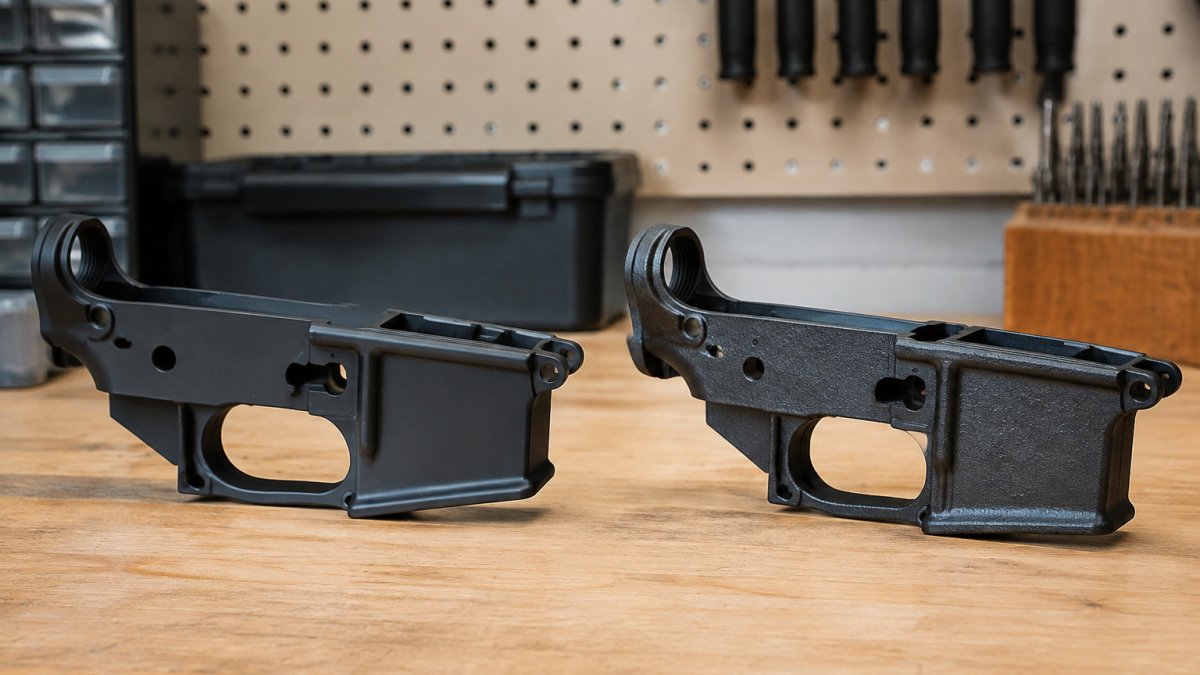
Forging shapes heated aluminum under pressure, while billet machining cuts a finished shape out of a solid block. That difference drives most of the trade-offs in this article.
Here is a quick summary of how the two compare on the factors most builders care about:
| Factor | Forged Lower | Billet Lower |
|---|---|---|
| Manufacturing method | Die forged, then finished | CNC machined from solid block |
| Typical cost | Lower | Higher |
| Weight | Generally lighter | Generally heavier |
| Design flexibility | Standard profiles | Custom and non-standard geometry |
| Fit and tolerance | Good, mil-spec focused | Often tighter tolerances |
| Best for | Duty use, budget builds | Custom aesthetics, unique designs |
Use this table as a starting point, then read the sections that match your priorities.
What Is a Forged Lower Receiver?
A forged lower receiver is a part made by pressing heated aluminum into a die, which forms the rough shape before final machining. The process aligns the metal’s grain structure with the shape of the part. According to JE Pistons, forgings generally have a superior grain structure compared to billet, which contributes to higher overall strength. JE Pistons technical blog on forging versus billet grain structure
Forged lowers are commonly made from 7075-T6 aluminum, a high-strength alloy used for firearm receivers.
The main drawback is limited design freedom. Because the shape is set by the die, forged lowers offer fewer aesthetic options than billet alternatives.
What Is a Billet Lower Receiver?
A billet lower receiver starts as a solid block of aluminum that a CNC machine carves into its final shape. Because the part is cut rather than pressed into a mold, designers can build in features that a forging die cannot easily produce. Para Bellum University notes that billet manufacturing allows design flexibility not possible with standard forged profiles. Para Bellum University analysis of billet receiver design flexibility
That flexibility is why billet lowers are popular with custom builders. Integrated features, flared magwells, and nonstandard geometry are all practical on a billet part. Billet lowers are commonly machined from 6061-T6 or 7075-T6 aluminum.
Machining generally takes more time than forging, which is one reason billet lowers often cost more.
Forged vs Billet Strength and Structural Integrity
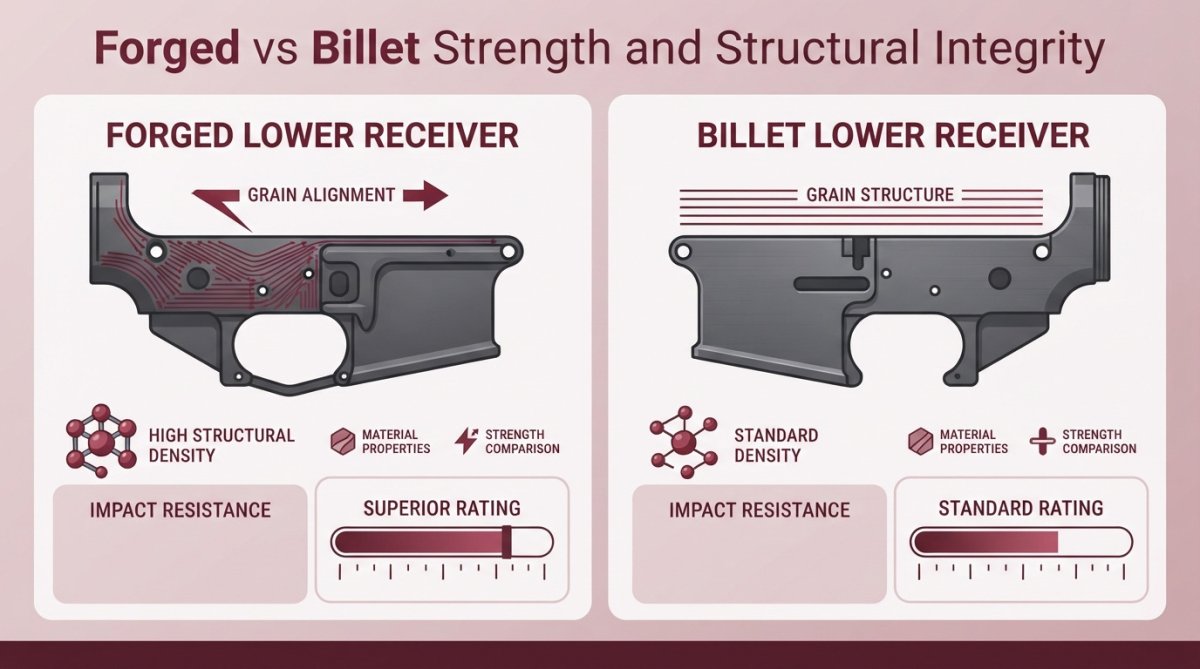
Strength is the question most buyers ask first, and both methods produce receivers strong enough for normal use. The difference shows up in how each part behaves under repeated stress.
Start with the alloy.
Forging’s real advantage is grain flow. Sincere Machining technical guide on forged versus billet strength JE Pistons technical blog on forging versus billet grain structure
Billet is not weak. A quality billet receiver machined from 7075-T6 with a proper heat treat and a good hard-coat anodizing job holds up well in normal use, and many competitive shooters run billet lowers for years without issue.
Metallurgical Testing Data and Grain Structure
The practical points a buyer can actually use are these:
- Ask for the alloy and temper. A maker who says “aircraft-grade aluminum” without naming 7075-T6 or 6061-T6 is telling you nothing verifiable. The alloy and heat treat drive the tensile and yield numbers far more than the manufacturing method does.
- Ask for the test method. Published tensile and yield figures should come with a stated alloy, heat treatment, specimen orientation, and test standard. A number without that context is a marketing claim, not test data.
- Understand what anodizing does and does not do. Mil-spec hard-coat anodizing (MIL-A-8625 Type III) builds an aluminum-oxide layer that improves wear and corrosion resistance, but it is a surface treatment, not a structural one. It does not change the underlying tensile or fatigue strength of the receiver.
- Watch the stress risers. The takedown-pin holes, the buffer-tower threads, and the pistol-grip screw boss are where cracks initiate in any lower. A forged part’s grain flow around those features is a genuine advantage; a billet part can match it with generous radii and adequate wall thickness.
Watch out: a maker who quotes a single tensile number without alloy, temper, and test method is giving you a marketing figure, not metallurgical data. Treat uncontextualized strength claims as advertising and ask for the spec sheet.
Gorilla Machining also describes forged lowers as the standard for proven performance and weight efficiency in duty use. Gorilla Machining billet versus forged lower guide That reputation is earned, but it does not mean a well-made billet lower is unsafe. For a duty or defensive rifle that will see high round counts and hard use, forged is the conservative choice. For a range, competition, or custom build where the design and fit matter more than the last increment of fatigue margin, a quality billet lower is a sound option.
Weight, Fit, Tolerance and Aesthetic Differences
Weight usually favors forged lowers. Because forging forms the part close to its final shape, less material gets removed, and the finished receiver is often lighter than an equivalent billet part. That matters if you are building a lightweight carbine.
Fit is more complicated. Billet machining can hold tighter tolerances, which can mean a snugger connection between upper and lower receivers. Some builders prefer that tighter fit, while others find it can make assembly harder if the parts are not matched well. Forged lowers built to mil-spec dimensions are designed for predictable compatibility with standard uppers and parts.
Aesthetics are where billet clearly leads. Custom profiles, unique cuts, and integrated features give billet builders options a forged die cannot easily offer. If the look of the finished rifle is a priority, billet is the better fit.
Billet vs Forged vs Cast: Where Each Method Fits
Cast receivers are a third option, and they are not the same as forged. Casting pours molten aluminum into a mold and is generally considered a less expensive method.
Here is how the three methods typically fit different builds:
- Forged: Best for duty and defensive rifles, budget-conscious builds, and anyone who wants a proven mil-spec foundation.
- Billet: Best for custom builds, unique aesthetics, and projects where nonstandard geometry matters.
- Cast: Usually the cheapest option, but it is generally considered the weakest of the three. Use it only with a clear understanding of the strength trade-off.
For most buyers choosing between billet and forged, cast is not the real decision. Focus on forged or billet first, then compare individual products within that category.
Price, Long-Term Wear and Finish Durability
Price is one of the clearest differences between the two methods. Here is the concrete picture.
Pricing for both forged and billet lowers varies with manufacturer, finish, and features, so check current product pages for specifics. Our material comparison guide covers durability, weight, and cost side by side. The spread comes from machining time, the design work baked into the part, and the finish. Forging is generally faster per part, while billet machining is generally slower per part.
Check each product page for current pricing, or contact Poly Pew for a quote on the parts you are considering. You can also browse affordable aluminum lower receiver upgrades for budget-friendly options that still meet mil-spec standards.
Long-Term Wear and Finish Durability
Long-term wear depends more on the finish and the maker than on the forging method. Both forged and billet lowers are typically finished with hard-coat anodizing, and the relevant spec is MIL-A-8625 Type III, which builds an aluminum-oxide layer that resists abrasion and corrosion.
Where the two diverge is surface preparation. A forged lower arrives at the finisher with a relatively uniform as-forged surface, so the anodize tends to build evenly. A billet lower has machined surfaces with tool marks, and the quality of the finish depends on how carefully the maker deburrs and preps those surfaces before anodizing.
When evaluating any billet lower, it is worth inspecting the inside of the magwell, the trigger pocket, and the takedown-pin holes for even anodize coverage.
Coating choices beyond anodizing also affect wear. Cerakote and similar spray-on finishes add color and some abrasion resistance but are thinner and less hard than Type III anodize; they are cosmetic and protective, not a substitute for a proper anodized base.
A few practical wear points apply to both types:
- Takedown-pin holes and the pivot/takedown interface see repeated assembly and disassembly. Anodize wear there is normal and cosmetic; bare aluminum exposed by wear should be monitored for corrosion.
- The buffer-tower threads and receiver-extension interface carry recoil load. Thread condition matters more than finish type here.
- The magwell takes the most abrasion from magazine insertion and removal. Hard-coat anodize handles this well; spray-on coatings wear through faster.
In practice, a forged lower with a good Type III finish and a billet lower with a good Type III finish wear similarly over time.
Choosing Your Next Lower for Your Build
Start with your build goal, then choose the material to match. A few questions will narrow the decision quickly:
- Is this a duty, defensive, or budget build? A forged lower is usually the right call.
- Are you building a custom rifle where looks matter most? Billet gives you more design options.
- Do you need the lightest possible receiver? Forged usually wins on weight.
- Are you matching a specific upper or drop-in kit? Confirm compatibility, since billet fit can vary.
Once you know your priority, check the products in that category and compare the finish, the included features, and the current price. If you are ready to build around a custom lower, see how to order custom MKE lower receiver parts and find components that fit your rifle. If you are building an AR-15, browse our range and reach out with any compatibility questions before you buy.
Frequently Asked Questions
Are billet or forged lowers better?
Neither is better across the board. Forged lowers are the usual pick for duty, defensive and budget builds because the forging process aligns the grain structure and yields a strong, light receiver, and forged lowers are available across a range of price points. Billet lowers are better suited to custom builds where unique geometry, machined features and tighter fitment matter more than price. Match the material to what your build needs.
Is a billet lower weaker than a forged one?
Not necessarily. Billet receivers are machined from solid aluminum billet and can be very strong, but forgings are often described as having a grain structure that favors strength. The gap depends on the specific alloy, heat treatment and design, so compare the actual specifications of the receivers you are considering.
What is the best forged lower receiver for a budget build?
For a budget build, a mil-spec forged lower made from 7075-T6 aluminum with a hard coat anodized finish is a common choice. Several manufacturers offer forged options, so check each manufacturer’s site for current prices before you buy.
Is a billet lower receiver worth the extra cost?
It depends on your goals. Billet lowers cost more because CNC machining takes longer, and they are often heavier than forged counterparts. If you want a custom look, non-standard geometry or machined features, the extra cost can be justified. If your priority is a durable, lightweight duty build, a forged lower usually delivers more value per dollar.