Last Updated: November 3, 2026
Quick Summary
A 15-yard zero is the best starting point for most pistol red dots used as a home defense optic, while a 36-yard zero suits an AR rifle setup. Choose your zero around the 3 to 25 yard distances inside and just outside your home, not a distant firing line.
- A pistol red dot sits about 0.7 to 1.0 inch above the bore, while an AR mount is usually 2.5 to 2.6 inches.
- Bring 30-50 rounds to the range so you can complete and verify the whole zeroing process.
- At 25 yards, 1 MOA is roughly 0.25 inches, so a 2-inch correction is about 8 clicks at 1 MOA.
- Confirm your zero with a 5-shot group at your zero distance and another at 7 yards.
- Recheck zero after reinstalling the optic, a hard drop, a mount change, or switching ammunition.
Table of Contents
- Pick Your Home Defense Red Dot Zero Distance Before You Fire
- Prep the Rifle and Optic: Mount, Torque, and Bore Sight
- How to Zero a Rifle Scope at 25 Yards: Live-Fire Procedure
- How to Zero a Red Dot on a Pistol at Home Without Firing a Shot
- How to Zero a Red Dot Without Shooting: Bore Sighting and Confirmation
- Adjustment Math, Close-Range Offset, and Confirming Your Zero
- Build Your Home Defense Optic Setup with Poly Pew Parts
- Frequently Asked Questions
Pick Your Home Defense Red Dot Zero Distance Before You Fire
The honest version: there is no universal answer. The right zero depends on your platform, optic height, and the distance you actually expect a threat.
Zero distance is the range at which your point of aim and point of impact line up perfectly. Everything closer or farther lands somewhere else.
A 25-yard zero is the traditional standard, per Foreseen Optics’ zeroing benchmarks(https://www.foreseenoptics.com/zero-stop-rifle-scopes). A 36-yard zero is a common rifle pick for managing close-quarters offset, per AR15.com community discussion.
The assumptions behind every zero recommendation
Every recommended zero is a bet on three variables: sight height over bore, ammunition velocity, and the range band you care about most. Change one and the offsets change with it. Before copying a number off a forum, check whether the person recommending it ran the same setup you do.
- Sight height over bore. A pistol red dot sits about 0.7 to 1.0 inch above the bore. An AR red dot on a standard mount is usually 2.5 to 2.6 inches; a 1.93-inch mount pushes that to roughly 2.8 inches or more. The higher the optic, the more impact lands low up close, and the more a farther zero helps flatten near-distance error.
- Ammunition velocity. Standard-pressure 9mm defensive loads and 55-grain 5.56 loads have very different trajectories. A 36-yard rifle zero tuned around one load will not produce identical offsets with a different bullet weight or velocity.
- The range band you care about. A home defense zero should be chosen around distances inside and immediately outside your home, typically 3 to 25 yards, not a 300-yard firing line you will never use.
What each zero actually does at realistic distances
Rather than present competing recommendations as if one is simply correct, here is how the common choices behave and who each suits. These are general patterns, not lab data, confirm your own offsets at the range.
| Setup | Recommended Zero | Why |
|---|---|---|
| Pistol red dot, home defense | 15 yards | Tight near-distance offset, easy to verify |
| AR rifle, home defense | 36 yards | Balances close-range offset and mid-range hold |
| Rifle scope, range use | 25 yards | Traditional standard, easy to confirm |
| Rifle, general purpose | 50 yards | Flatter mid-range trajectory |
| Precision or long-range | 100 yards | Best far accuracy, worst close offset |
- 10-yard zero (pistol or rifle). Very tight inside the home, but impact climbs noticeably past 25 yards. Good if your only realistic engagement distance is a hallway.
- 15-yard zero (pistol red dot). A common defensive pistol choice. The dot stays close to point of aim from about 5 to 25 yards, covering most indoor and immediate-property distances.
- 25-yard zero (rifle or pistol). The traditional standard and easiest to confirm on a typical indoor range. On a rifle with a standard mount, impact at 7 yards lands low by roughly the sight height plus a small trajectory penalty, often 2 to 3 inches below the dot.
Match the zero to the platform, not the trend
A pistol red dot and a rifle red dot should not share a zero just because both are red dots. The pistol’s lower sight height means a 15-yard zero keeps offsets small across the distances you actually shoot.
Watch out: copying a zero from someone running a different sight height or ammunition is the most common reason a new setup shoots low at 7 yards and the shooter blames the optic.
Prep the Rifle and Optic: Mount, Torque, and Bore Sight
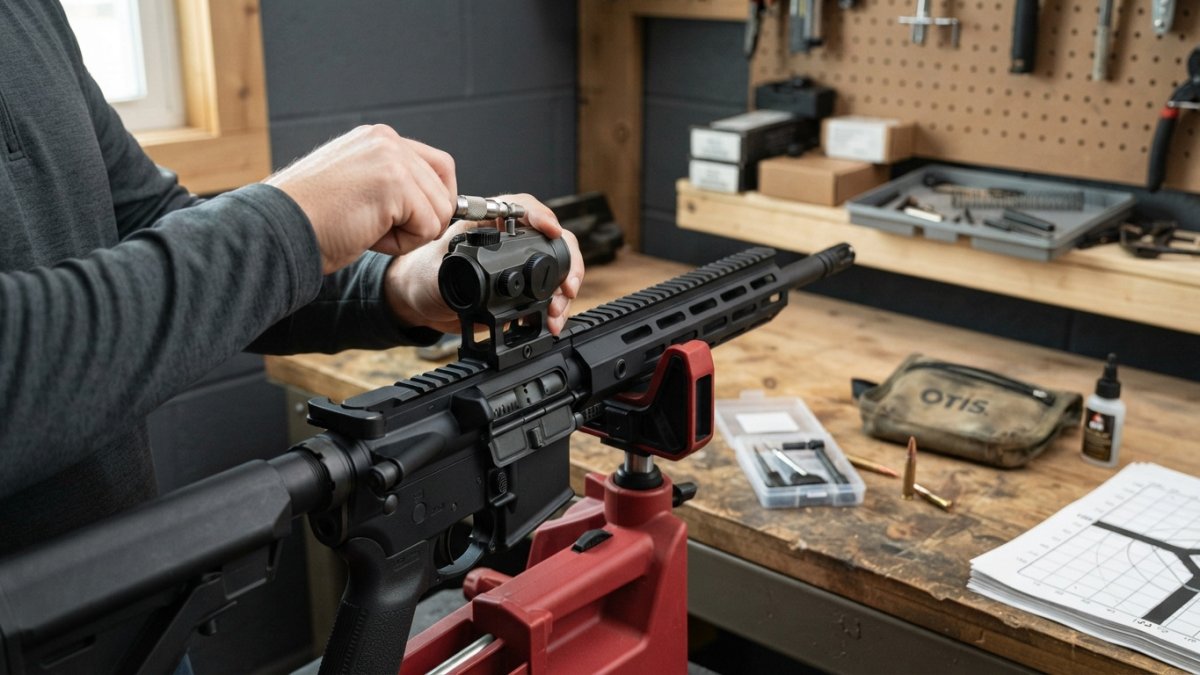
Proper mount torque is the single biggest factor in keeping zero under recoil, per Strike Industries’ T1-VOM hold-zero testing. Skip this and you will re-zero forever.
Work through this checklist before you fire a shot:
- Clean the mounting surface and remove all oil
- Apply thread locker to mount screws
- Torque screws to the manufacturer’s spec with a real torque driver
If you are assembling the rifle at the same time, our performance firearm parts for custom builds cover triggers and related components.
Bore sighting is not zeroing. It just gets your first shot on paper so you stop wasting ammo.
How to Zero a Rifle Scope at 25 Yards: Live-Fire Procedure
Bring 30-50 rounds to the range so you can complete and verify the whole process, per Gold Trigger’s zeroing prep guidance. Most people bring too few.
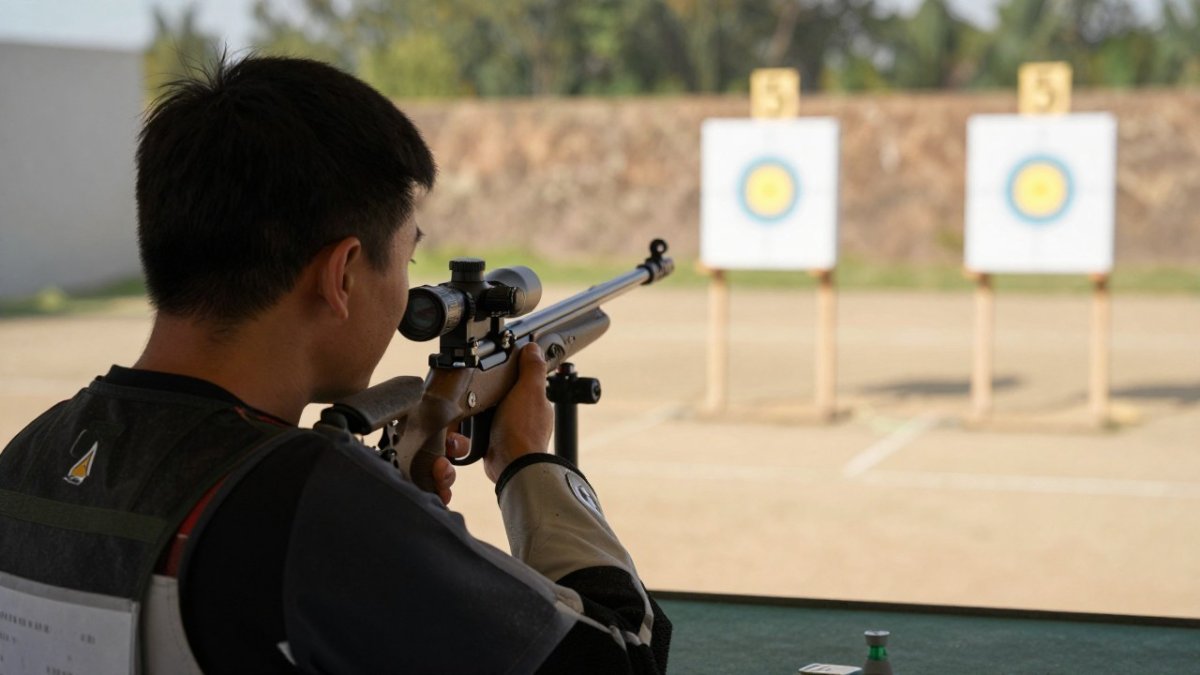
- Set a paper target at exactly 25 yards, measured, not paced.
- Fire a 3-shot group from a rest, slowing down between shots.
- Find the group center, not the single best hole.
- Measure from group center to your aim point.
- Adjust elevation and windage the calculated amount.
- Fire another 3-shot group to confirm.
- Repeat until group center sits on the aim point.
Fire 5-shot groups once you are close. Three shots confirm direction; five confirm consistency.
How to Zero a Red Dot on a Pistol at Home Without Firing a Shot
You can get a pistol red dot very close at home with dry fire and a laser cartridge. Pistol owners can also explore pistol accuracy: affordable mods that work like sights and dry-fire drills that tighten groups.
How to zero a red dot without shooting comes down to three tools: a stable rest, a laser bore cartridge, and a small target at a measured distance.
- Lock the pistol in a vise or stable rest, pointed at a safe backstop.
- Insert the laser bore cartridge.
- Set a target at 15 yards, or the longest distance your home allows.
- Activate the laser and mark where it lands.
- Adjust the dot until it sits on the laser mark.
- Dry fire 10-15 reps to check the dot holds through trigger break.
Watch out: a laser cartridge that is not seated fully will throw your adjustment off by inches. Seat it, then re-check.
How to Zero a Red Dot Without Shooting: Bore Sighting and Confirmation
Bore sighting gets you on paper. It does not replace live confirmation.
Two ways to bore sight:
- Laser bore cartridge: fast, works indoors, good for pistols and rifles.
- Visual bore sight: remove the bolt or BCG, look through the barrel at a target, and match the dot to it.
Either method should land you within a few inches at 25 yards, close enough to start live fire without wasting a box of ammo.
The step people skip: confirming. Fire one group at your chosen zero distance, then a second at 7 yards. That second group shows what your close-range offset actually looks like.
Adjustment Math, Close-Range Offset, and Confirming Your Zero
Most red dots adjust in 1 MOA or 0.5 MOA clicks, per A Girl & A Gun’s adjustment guidance, but check your specific optic’s manual. This is where people guess and waste ammo.
The math at 25 yards:
- 1 MOA at 25 yards = roughly 0.25 inches
- So a 2-inch correction = about 8 clicks at 1 MOA
- At 0.5 MOA clicks, double it
At 50 yards, 1 MOA is about 0.5 inches. At 100 yards, about 1 inch. Adjust your click count to the distance.
Translate your group into a click count
Do not eyeball the adjustment. Measure from your aim point to the center of your group, convert that distance to MOA at your zero distance, then divide by your optic’s click value.
- Measure the horizontal and vertical offset separately, in inches.
- Convert inches to MOA: at 25 yards, divide inches by 0.25; at 50 yards, divide by 0.5; at 100 yards, divide by 1.0.
- Divide the MOA figure by the click value (1 MOA or 0.5 MOA) to get the click count.
- Turn the turret in the direction that moves impact toward the aim point, then fire a confirmation group.
A worked example: a 25-yard group centered 2 inches low and 1 inch right, with 1 MOA clicks. Vertical: 2 ÷ 0.25 = 8 MOA, so 8 clicks up. Horizontal: 1 ÷ 0.25 = 4 MOA, so 4 clicks left.
Watch out: turret direction labels vary between optics, and some turrets move point of impact in the direction of the arrow while others move the reticle.
Sight height drives your close-range offset
Now the part most guides skip: sight-to-bore offset. Your optic sits above the barrel. At very short ranges, that height difference is the main reason impact lands low, per Reddit r/ar15 discussion on height over bore.
A rough way to think about it: inside your zero, the bullet has not yet risen to meet the line of sight, so impact sits below the dot by roughly your sight height plus a small trajectory penalty.
Verify at two distances, not one
Confirm your zero with this routine:
- Fire a 5-shot group at your zero distance.
- Fire a 5-shot group at 7 yards.
- Record both group centers and the point-of-aim to point-of-impact offset at each distance.
- Re-check after 200 rounds, then after any hard bump.
That 7-yard group is the number that matters for home defense. Write it down and tape it inside your range bag. If your near-distance offset is larger than you are comfortable with, either accept it and train to it or move your zero closer.
When to re-zero
Zero retention matters. Optics that hold through thousands of rounds without shifting are the ones worth owning, per Firefield’s zero retention notes. Recheck zero after removing or reinstalling the optic, after a hard impact or drop, after changing mounts or ring height, and after switching ammunition lot or bullet weight. A quick 5-shot confirmation at your zero distance catches most shifts before they matter.
Build Your Home Defense Optic Setup with Poly Pew Parts
A zero only holds if the parts under it hold. That is the whole argument.
If you are still choosing an optic, that same guide covers what to look for.
The challenge is simple: most shooters re-zero because something moved. Fix the platform first.
Get started with Poly Pew and build a home defense setup that holds zero when it counts. Get your Flatties here.
Frequently Asked Questions
What distance should I zero a red dot for home defense?
For a rifle, a 36-yard zero is a common defensive choice because it keeps point of impact close to point of aim out to 25+ yards while managing close-quarters offset. For a pistol red dot, a 15-yard zero gives reliable performance from close range out to 25+ yards. The right answer depends on your platform, sight height over bore, and the distances you actually train at, so pick one distance, verify it, and stick with it.
Can I zero an optic at home without firing?
Yes. Bore sighting or using a digital zeroing tool can get you on paper before you fire a shot. Bring 30-50 rounds to the range to confirm and refine the zero. Home zeroing saves time and ammo, but always confirm with live fire before you trust the setup for home defense.
How do I adjust a red dot when shots are hitting high or low?
Most red dot sights adjust in 1 MOA or 0.5 MOA increments, so check your optic’s manual first. At 25 yards, one MOA equals roughly a quarter inch. If your group center is 2 inches low, that is about 8 MOA of elevation correction. Make the adjustment, fire a new 3-5 shot group, and repeat until the group center sits on your point of aim.
How often should I check an optic’s zero?
Check zero after any mount change, drop, or deep cleaning, and at least once per season for a home defense firearm. Zero retention under recoil depends on proper mount torque, so re-verify after the first 100-200 rounds on a new build. A quick confirmation group at your zero distance and one at close range takes only a few minutes and catches problems before they matter.