Last Updated: October 22, 2026
Quick Summary
Match grade barrels are pistol barrels made to tighter dimensional tolerances and inspected to stricter standards than standard factory barrels, covering the bore, chamber, crown, and locking surfaces. The term is not regulated and describes how carefully a barrel was made, not a guaranteed accuracy number. Fit to your specific slide and frame matters separately and often more than the label.
- Match grade is a manufacturing claim, not a performance promise, and no government standard certifies it.
- Confirm your exact pistol model, generation, and caliber before ordering any barrel.
- Drop-in barrels install in minutes with basic tools; gunsmith-fit barrels take days to weeks and offer higher accuracy potential.
- Test with one ammunition, a rest, 25 yards, and averaged ten-shot groups to judge a barrel honestly.
- Never force a barrel into a slide; stop and have a qualified gunsmith inspect it if it binds.
Table of Contents
- What Match Grade Actually Means on a Pistol Barrel
- Pistol Barrel Material and Rifling: What You’re Paying For
- Pistol Barrel Compatibility: Model, Caliber, and Generation Checks
- Drop-In vs Gunsmith-Fit Pistol Barrel: Which Route Fits Your Build
- Match-Grade Pistol Barrel Accuracy: Realistic Gains and Hard Limits
- A Step-by-Step Selection Framework for Your Pistol Platform
- Installation, Safety, and When to Hand It to a Gunsmith
- Conclusion
- Frequently Asked Questions
What Match Grade Actually Means on a Pistol Barrel
Match grade barrels are pistol barrels made to tighter dimensional tolerances and inspected to stricter standards than a standard factory barrel.
That distinction matters because “match grade” is not a regulated term. There is no government standard that certifies a barrel as match grade.
Here’s what most guides get wrong: they treat “match grade” as a performance promise. It isn’t. It’s a manufacturing claim.
Match grade means tighter manufacturing tolerances. It does not mean the barrel will fit your specific pistol well. Fit is a separate variable, and it often matters more than the label.
Pistol Barrel Material and Rifling: What You’re Paying For
Barrel steel is usually the first thing buyers ask about.
Rifling is the spiral cut inside the bore that spins the bullet. Two types dominate pistol barrels:
- Button rifling: A button is pulled through the bore to press the grooves in. Common and cost-effective.
- Cut rifling: Grooves are cut one at a time. Slower to make, often found in higher-end barrels.
- Broached rifling: A broach cuts all grooves at once. Common in factory barrels.
The crown is the muzzle end of the barrel. A clean, even crown protects accuracy because an uneven crown lets gas escape unevenly as the bullet exits. Match barrels typically get extra attention here.
Chamber dimensions also matter. A tight chamber can improve accuracy potential but may reduce reliability with certain ammunition. A loose chamber feeds almost anything but gives up some precision.
Pistol Barrel Compatibility: Model, Caliber, and Generation Checks
Compatibility is where most expensive mistakes happen. A match grade barrel for a Glock 17 will not fit a Glock 19. Same brand, different model, different barrel.
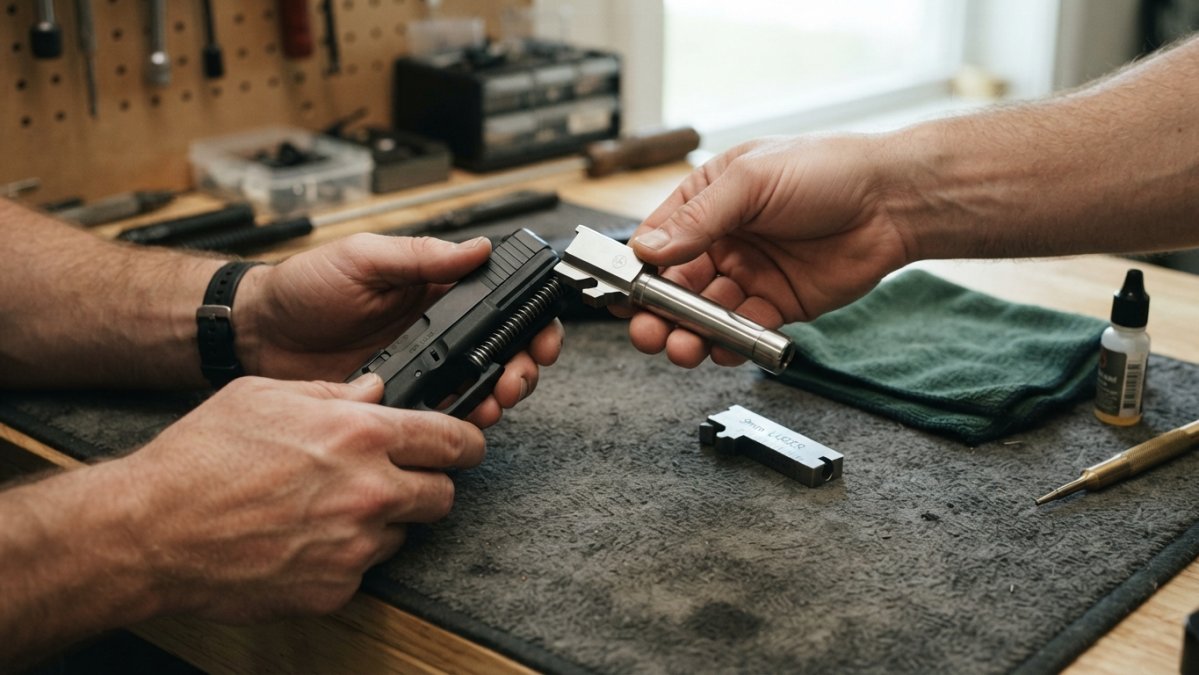
Before you buy, run these checks:
- Confirm the exact pistol model and generation
- Confirm the caliber matches the barrel
- Check whether the barrel is drop-in or requires fitting
- Verify the barrel hood and locking block geometry match your slide
- Check for left-hand or right-hand thread if you run a suppressor
Generation differences trip up a lot of builders. A study in Forensic Science International on Glock Marksman barrels examined Gen5 barrels specifically, which shows how much generation-level design changes matter.
Buying a barrel by brand name alone is the most common compatibility mistake. “Fits Glock” is not the same as “fits your Glock.” Always match model, generation, and caliber before ordering.
Drop-In vs Gunsmith-Fit Pistol Barrel: Which Route Fits Your Build
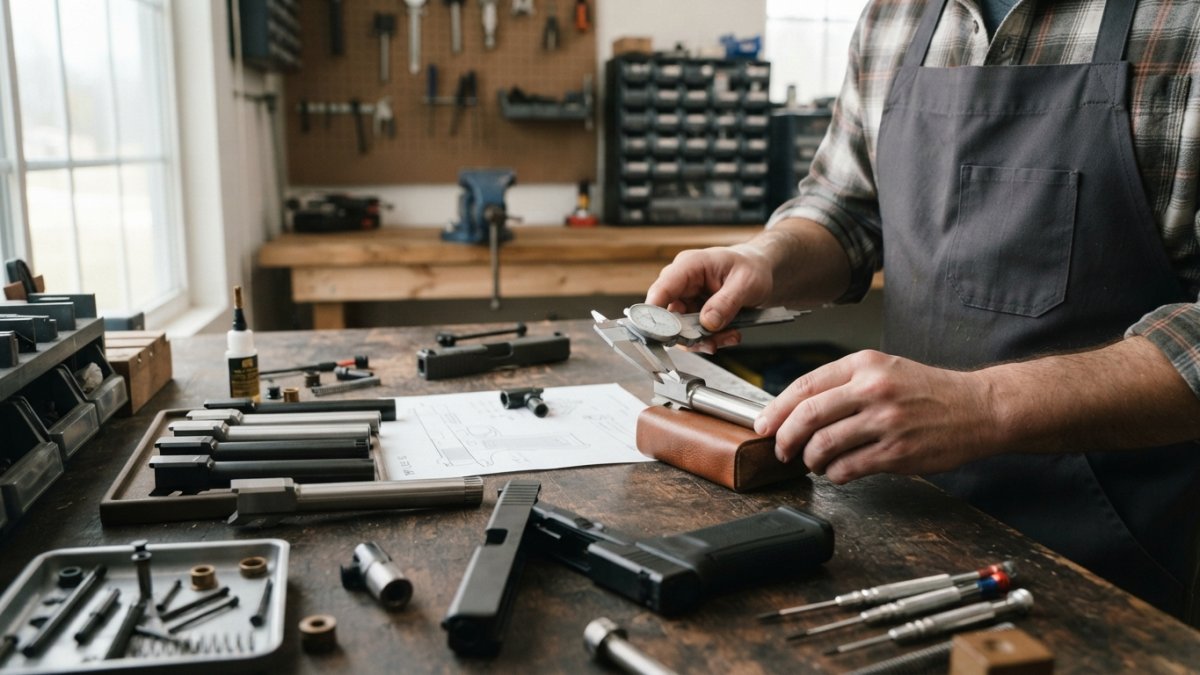
A drop-in barrel is designed to install with no permanent modification to the barrel or the slide. A gunsmith-fit barrel requires hand fitting of the hood, locking surfaces, or bushing to your specific slide and frame. The label on the box is a design intent, not a guarantee, many “drop-in” barrels still need minor fitting on some pistols, and a barrel that binds is not drop-in no matter what the listing says.
What actually gets fitted
- Barrel hood: The rear top surface that indexes against the slide’s breech face. Too long and the slide won’t go into battery; too short and headspace and lockup suffer.
- Locking lugs and slide recesses: These determine vertical lockup. They must engage evenly, not on one side.
- Barrel bushing (on bushing-style pistols like the 1911): Controls the muzzle end. A tight bushing improves consistency but can bind if not fitted.
- Link and slide stop (1911 pattern): The link length and slide stop pin fit affect unlock timing and reliability.
- Feed ramp and chamber throat: Some barrels need throat polishing or ramp work to feed certain bullet profiles reliably.
The decision points
| Route | Skill Required | Time | Accuracy Potential | Best For |
|---|---|---|---|---|
| Drop-in | Basic tools | Minutes | Good | First-time builders, budget builds, carry guns that must run |
| Gunsmith-fit | Professional fitting | Days to weeks | Higher | Competition and precision builds |
Use these decision points before you buy:
- Does the barrel seat by hand? If it drops in and the slide cycles smoothly with snap caps, it’s behaving as drop-in. If it binds, stop.
- Does the slide go fully into battery? A barrel that holds the slide out of battery is a safety issue, not a break-in issue.
- Does it lock up evenly? Check lug engagement with layout fluid or marker. One-sided engagement means the barrel needs fitting.
- Will you remove material? If the answer is yes, that’s gunsmith territory for most builders. Removing material from the wrong surface can ruin headspace or create a safety hazard.
- Is this a carry or defensive gun? Reliability outranks a fraction of an inch of group size. A tight, temperamental barrel is a poor choice for a pistol that must run.
A common mistake is assuming the match grade barrels label beats a well-fitted factory barrel. Owners on forums like The Firing Line discussion on match barrels point out that a properly fitted standard barrel can match a poorly fitted match barrel. The fit does the work.
Never force a barrel into a slide, and never remove material from locking surfaces or the hood without knowing exactly what you’re changing. Forcing a tight barrel can damage the locking surfaces and create a safety hazard. If it doesn’t seat by hand, stop and have a qualified gunsmith inspect it.
If you’re new to building, start with a drop-in barrel and confirm it runs before you chase accuracy. Save gunsmith fitting for a build where you already know the slide and frame are true and you’ve decided reliability can take a back seat to precision.
Match-Grade Pistol Barrel Accuracy: Realistic Gains and Hard Limits
Match-grade pistol barrel accuracy gains are real but modest in most hands, and the only way to know what a barrel actually bought you is to measure it the same way twice. The barrel is one part of a system that includes the shooter, ammunition, sights, and the fit between slide and frame. Expect tighter groups only when everything else is tight too.
Build a baseline before you swap the barrel
A before-and-after comparison is worthless if the “before” was shot on a different day with different ammo. Establish a baseline first:
- Pick one ammunition. Use the same load, bullet weight, and lot number for baseline and post-swap testing. Bulk ammo varies enough between lots to swamp a barrel change.
- Shoot from a rest. Sandbags or a bench rest remove the shooter variable. Offhand groups measure you, not the barrel.
- Fix the distance. 25 yards is the common pistol accuracy benchmark; use the same distance every session.
- Fire enough rounds. Five-shot groups are noisy. Ten-shot groups, repeated three to five times, give a more honest picture of what the barrel and ammo will do.
- Record everything. Distance, ammo, rest type, group size, and any flyers. A simple notebook beats memory.
How to read group size honestly
Measure center-to-center of the two farthest holes, not edge-to-edge. Report the average of your repeated groups, not your best one. A barrel that shrinks your average 10-shot group from 3 inches to 2.5 inches at 25 yards has done real work; a single 1.5-inch group surrounded by 4-inch groups is noise.
Be skeptical of accuracy claims that don’t state distance, ammunition, rest, and number of shots. A maker’s “1-inch guarantee” means little without those four details. Most practitioners find that barrel-to-barrel differences show up most clearly with match ammunition and a locked-down rest, and disappear with bulk ammo and offhand shooting.
What limits accuracy beyond the barrel
- Ammunition quality: Bulk ammo varies. Match ammo does not.
- Slide and frame fit: Play here shows up on target.
- Shooter technique: Grip and trigger control dominate group size.
- Sight alignment: A great barrel with bad sights is wasted.
- Trigger weight and break: A heavy, gritty factory trigger masks barrel improvement.
Test the barrel, not the label. Same ammo, same rest, same distance, ten-shot groups, averaged across several strings. If the barrel doesn’t shrink your average group, it didn’t help, regardless of what the box says.
A Step-by-Step Selection Framework for Your Pistol Platform
Use this framework to pick a barrel without guessing. It works for 1911s, Glocks, and most striker-fired and hammer-fired platforms.
- Lock your platform details. Write down model, generation, caliber, and barrel length.
- Decide drop-in or gunsmith-fit. Match this to your skill and budget.
- Check compatibility first. Confirm the barrel hood, locking surfaces, and link or bushing match your slide.
- Compare materials and rifling. Stainless steel and cut rifling are common match choices.
- Confirm the crown and chamber spec. Ask the maker for these details.
- Set a realistic accuracy goal. Decide what group size you actually need.
- Plan the install. Know whether you’re doing it or a gunsmith is.
At Polymer Pew, we see builders skip step three and pay for it later. Compatibility checks save money and range trips.
Installation, Safety, and When to Hand It to a Gunsmith
Safety comes before accuracy every time. Treat every pistol as loaded, keep the muzzle pointed in a safe direction, and clear the firearm before you touch the barrel.
Basic drop-in installation steps:
- Clear and field-strip the pistol.
- Remove the factory barrel.
- Test-fit the new barrel by hand. It should seat without force.
- Check for binding when the slide cycles.
- Reassemble and function-check with snap caps.
- Live-fire test at the range.
Hand it to a gunsmith if the barrel binds, if the slide won’t go into battery, or if you’re fitting a barrel that requires material removal. Fitting is not a DIY job for most builders.
Never force a barrel into a slide. Forcing a tight barrel can damage the locking surfaces and create a safety hazard. If it doesn’t seat by hand, stop and get it checked.
Conclusion
Picking the right barrel comes down to fit, not labels. Get your model, generation, and caliber right, decide between drop-in and gunsmith-fit, and test honestly at the range.
At Polymer Pew, we build components for people who care about compatibility and reliability. Our aluminum MKE lower receivers are tested for variant compatibility, our full metal kits use anodized aluminum housings with stainless steel internals, and our flat triggers and super safety kits are built for builders on a budget.
Get your Flatties here and start your next build with parts that fit the first time.
Frequently Asked Questions
Does a match-grade barrel make a difference in pistol accuracy?
It can, but the gain is usually smaller than shooters expect. A well-made, properly fitted factory barrel can shoot as accurately as a match-grade one, and a poorly fitted match barrel may not improve anything. Group size depends on the whole system: slide fit, frame fit, ammunition, and the shooter. Match grade barrels for pistols pay off most when the rest of the gun and your ammo are already consistent, so fix those first.
Will a match-grade barrel fit a stock pistol?
Only if it is a true drop-in barrel made for your exact model and generation. Many match-grade barrels ship slightly oversized at the barrel hood, locking surfaces, or bushing area and need fitting. Check pistol barrel compatibility before ordering: model, caliber, and generation all matter. If the listing says gunsmith fit, assume it will not drop into a stock slide without work.
What is the difference between a drop-in and a gunsmith-fit pistol barrel?
A drop-in barrel is machined to fit a factory slide with little or no modification, so you install it yourself. A gunsmith-fit barrel leaves material on the hood, lugs, and link area so a gunsmith can hand-fit it to your specific slide and frame for a tighter lockup. Drop-in is faster and cheaper; gunsmith fit costs more and takes time but can tighten tolerances. For most builds, a quality drop-in is the practical choice.