Table of Contents
- Why Drop-In Triggers Make Sense for First-Time AR-15 Owners
- AR-15 Drop-In Trigger vs Mil-Spec Trigger: What Actually Changes
- How Drop-In Triggers Work and Where They Improve Feel
- Single-Stage vs Two-Stage AR-15 Trigger: Which Fits a Beginner
- AR-15 Trigger Installation and Compatibility Checks Before You Buy
- AR-15 Trigger Safety and Reliability: What Beginners Should Verify
- Pros, Cons, and Cost: Is a Drop-In Trigger Worth It for a Beginner?
- Conclusion
- Frequently Asked Questions
Last Updated: October 21, 2026
Why Drop-In Triggers Make Sense for First-Time AR-15 Owners
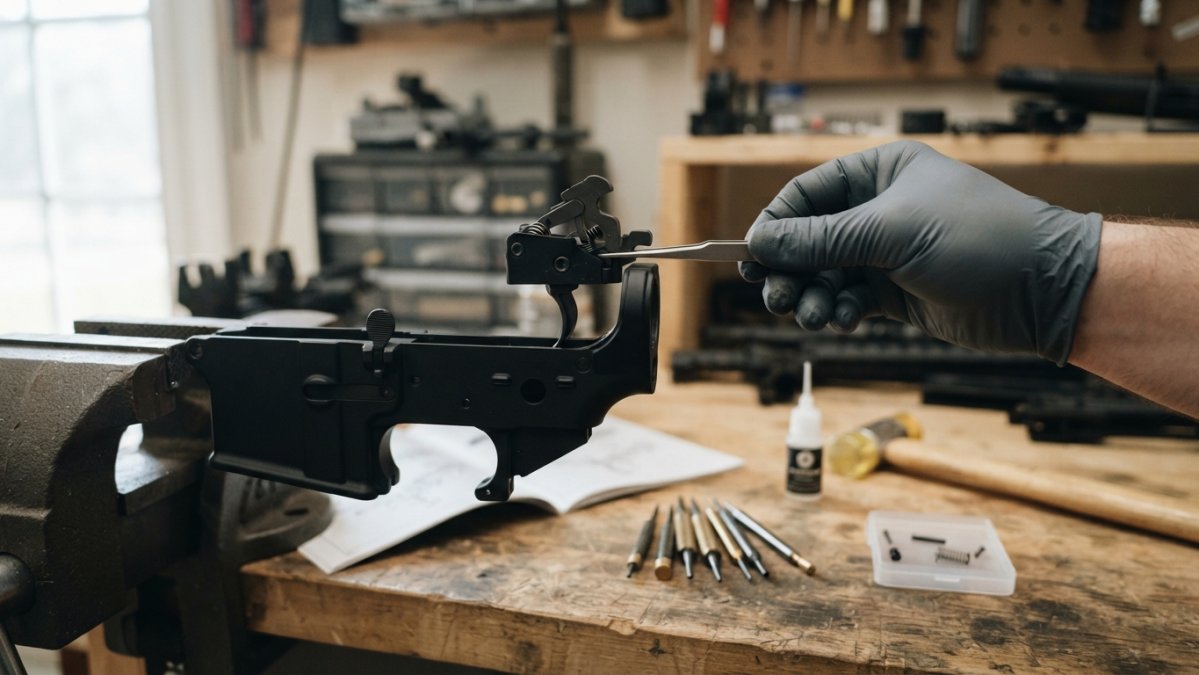
If you’ve just built or bought your first AR-15, the trigger is the part most likely to frustrate you first. Drop-in triggers are self-contained fire-control assemblies that replace the standard hammer, trigger, and disconnector with one pre-assembled unit, removing most of the guesswork from an upgrade.
Here’s the honest answer up front: a drop-in trigger won’t make you a better shooter. It will make your rifle easier to shoot consistently, which matters more when you’re still learning fundamentals.
The SAAMI pressure and cartridge standards and basic AR-15 design documentation both confirm the fire-control group is a drop-in-compatible system by design, which is why aftermarket units exist at all.
A drop-in trigger’s real beginner benefit is consistency: the same pull, break, and reset every time, so you can focus on sight picture and trigger control instead of fighting a gritty mil-spec trigger.
AR-15 Drop-In Trigger vs Mil-Spec Trigger: What Actually Changes
The core difference between an AR-15 drop-in trigger and a mil-spec trigger is how the parts are made and fitted. A mil-spec group uses mass-produced stamped and cast components with looser tolerances, while a drop-in unit houses precision-machined sear surfaces inside a self-contained housing, a change that affects pull weight, creep, and reset far more than any polish job.
Here’s what actually changes in practice:
- Sear engagement is machined to a fixed angle instead of relying on a gunsmith’s stoning
- Pull weight is set by the manufacturer’s spring rates, not by chance
- Installation drops the whole assembly in as one piece instead of stacking pins and springs
A mil-spec trigger isn’t “bad”, it’s built to a durability and cost standard, not a feel standard. A drop-in trigger trades some of that margin for better feel, and that trade-off is the whole decision.
How Drop-In Triggers Work and Where They Improve Feel
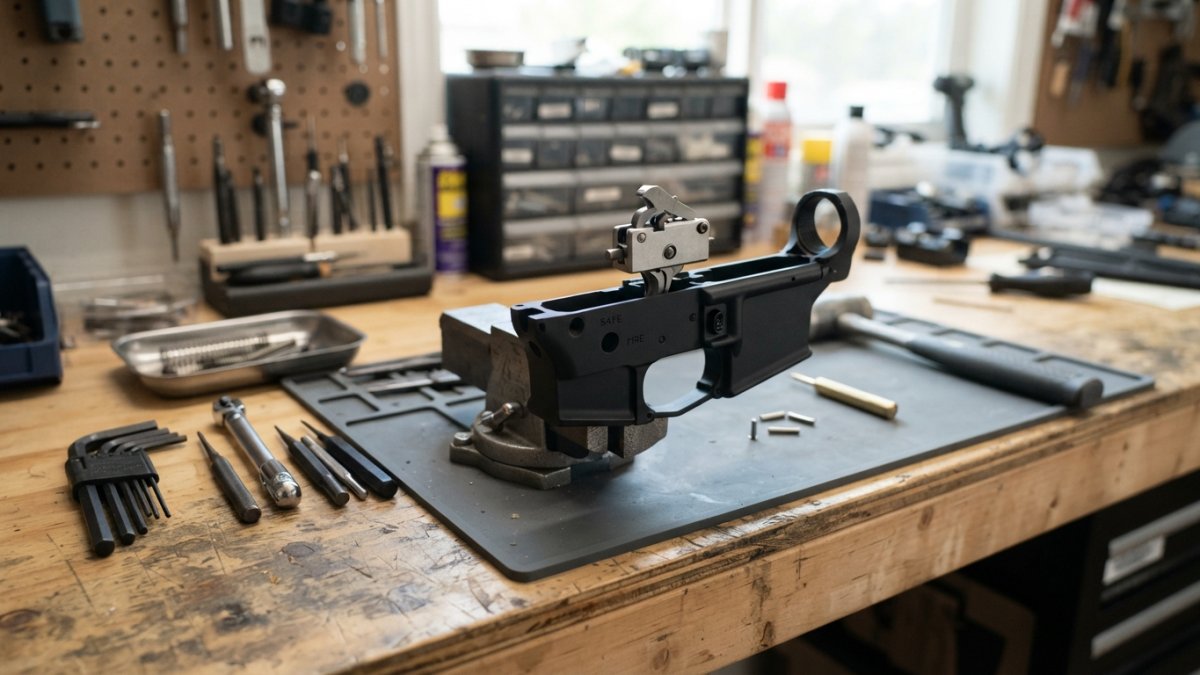
A drop-in trigger contains the hammer, trigger, disconnector, and springs inside a single housing that pins into the lower receiver’s fire-control pocket. Because the sear surfaces are pre-fit at the factory, the trigger-to-hammer interaction is consistent from unit to unit, that’s where the feel improvement comes from.
Pull Weight, Creep, Break, and Reset Explained
Four characteristics define trigger feel:
- Pull weight is how much force it takes to fire. Too light for a new shooter can mask poor trigger discipline.
- Creep is the slack movement before the shot breaks. Less creep means a more predictable break.
- Break is the moment the sear releases the hammer. A “clean break” happens without grit or stacking.
A good drop-in trigger improves all four at once because they’re machined as a system, not assembled from mixed parts.
Single-Stage vs Two-Stage AR-15 Trigger: Which Fits a Beginner
For most beginners, a single-stage trigger is the better starting point: one continuous pull with no distinct take-up, so the shot breaks at the end of a short, consistent travel.
Here’s how to decide:
| Trigger Type | Feel | Best For | Beginner Fit |
|---|---|---|---|
| Single-stage | Short, consistent pull | General-purpose use, hunting, defensive setups | Easiest to learn on |
| Two-stage | Take-up, then a wall | Precision and competition shooting | Better once fundamentals are solid |
| Flat trigger shoe | Consistent finger placement | Precision work, repeatable index | Good if you train deliberately |
| Curved trigger shoe | Familiar mil-spec feel | General-purpose use | Most familiar to new shooters |
The flat versus curved shoe question comes down to finger placement consistency. A flat shoe gives a repeatable index point; a curved shoe feels like what you already know. Neither is “better,” but a beginner usually benefits from the familiar option first.
If you’re torn between single-stage and two-stage, pick single-stage for your first upgrade. You can always move to a two-stage later once you know what a clean break feels like, and you’ll appreciate the difference more.
AR-15 Trigger Installation and Compatibility Checks Before You Buy
Drop-in trigger installation is genuinely beginner-friendly: remove the old trigger group, drop the new housing into the lower receiver’s fire-control pocket, and secure it with the provided pins.
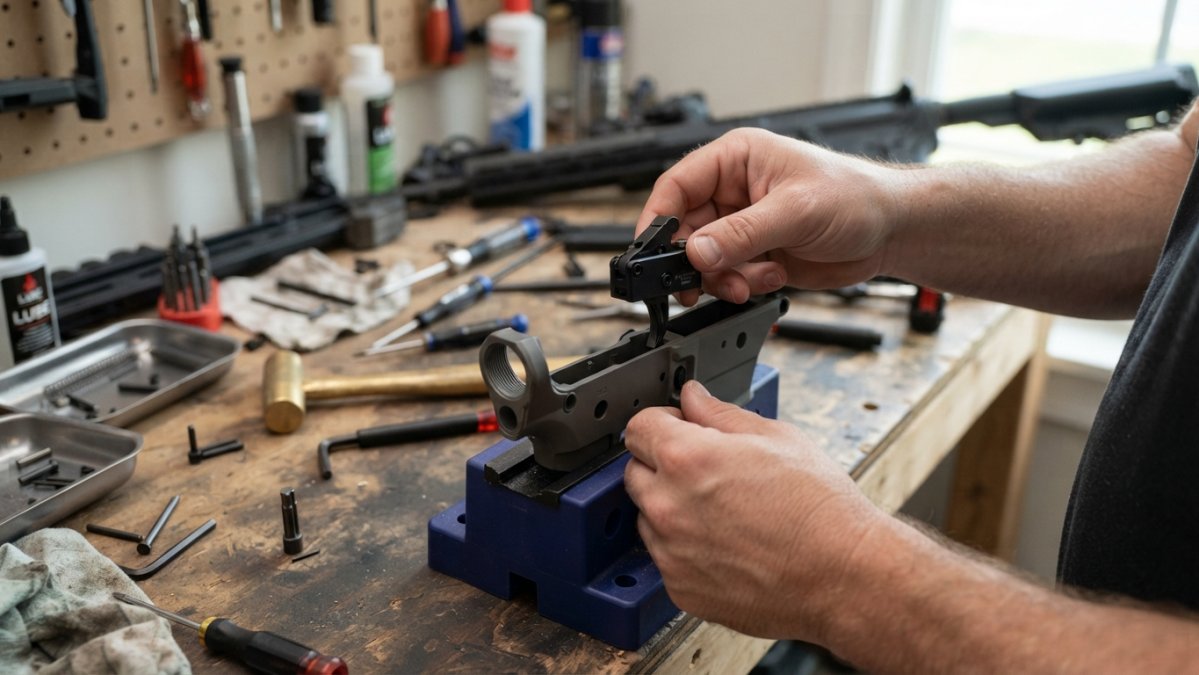
Compatibility is where beginners get burned, so check these before you buy:
- Confirm the lower receiver is mil-spec pin diameter (most are, but confirm yours)
- Check the fire-control pocket depth against the manufacturer’s spec
- Verify the unit is designed for your caliber and platform variant
A common mistake is buying a drop-in kit for a lower with non-standard pin sizes or an oversized pocket, then discovering it binds or sits loose. Our ATF guidance on firearm component definitions is worth reading if you’re unsure how the fire-control group is classified for your build.
AR-15 Trigger Safety and Reliability: What Beginners Should Verify
Safety and reliability checks matter more than trigger feel for a new shooter. A lighter, cleaner trigger is easier to shoot well, and easier to fire by accident. Here are the checks and habits that go with it.
Why a Lighter Trigger Raises the Stakes for a Beginner
A drop-in trigger often reduces pull weight and shortens the travel before the shot breaks. For an experienced shooter that’s a benefit; for a new shooter still learning trigger discipline, a drifting finger or rushed press is more likely to produce an unintended shot. The fix isn’t to avoid the upgrade, pair it with training and strict handling rules.
- Keep the finger off the trigger until the sights are on target and you’ve decided to shoot.
- Treat every rifle as loaded and confirm the chamber is clear before handling or function testing.
- Use a safe direction and a backstop any time the rifle is loaded.
Mechanical Checks Before You Trust the Trigger
Run these checks on an unloaded rifle, pointed in a safe direction, with the magazine removed and the chamber verified clear:
- Function test: cycle the action and confirm the disconnector holds the hammer until you release the trigger. Release the trigger and confirm the disconnector hands the hammer back to the trigger.
- Safety test: confirm the safety blocks the trigger in the safe position and engages positively in both positions. Check that the selector still moves freely with the new unit installed.
- Drop test: with the rifle unloaded and the safety engaged, confirm no hammer release from a light bump. Repeat with the safety off only in a controlled setting and a safe direction.
Reliability Over Time: What to Inspect and When to Stop
Reliability comes down to material quality and routine inspection. Hardened stainless steel internals and anodized aluminum housings resist wear better than softer metals, but every trigger deserves a periodic look, after heavy range sessions, after any drop or impact, and before a match or hunt.
Signs of abnormal function, stop shooting and have the rifle inspected by a qualified gunsmith if you see any of these:
- The reset feels mushy, inconsistent, or fails to reset
- The hammer follows the bolt forward during function testing
- The safety becomes stiff, loose, or fails to block the trigger
A trigger that changes feel is telling you something. Don’t shoot through it, inspect it, and if you’re not confident in the diagnosis, let a professional look at it.
Never function-test a new trigger with live ammunition or in an unsafe direction. A disconnector that fails to catch the hammer can cause an unintended discharge, and that failure is exactly what the unloaded function test is designed to catch. Pair every mechanical check with the handling habits above, the trigger can only be as safe as the shooter operating it.
Pros, Cons, and Cost: Is a Drop-In Trigger Worth It for a Beginner?
A drop-in trigger is worth it for a beginner who wants a consistent, predictable trigger without gunsmith work. It’s not worth it if you expect it to fix accuracy problems that come from fundamentals. Weigh the total cost against what else that money could buy.
Pros:
- Consistent pull weight and break from unit to unit, so you learn on the same feel every range trip
- Easy installation with basic tools, no stoning, no sear fitting, no gunsmith appointment
- Better trigger feel than a stock mil-spec unit, which makes it easier to isolate trigger-control mistakes
Cons:
- Costs more than a stock mil-spec trigger group
- Fitment varies by lower receiver, so you must check compatibility before buying
- A lighter pull can mask poor trigger discipline in a new shooter
What a Trigger Upgrade Actually Buys You
A drop-in trigger changes the interface between you and the shot, pull weight, creep, break, and reset. It does not change barrel quality, sight alignment, breathing, or follow-through. If you’re jerking the trigger, a cleaner break helps you feel and correct that; if you’re flinching or your optic is loose, a trigger won’t fix it. Most instructors will tell you ammunition and range time produce bigger gains per dollar, until the trigger is the thing holding you back.
Total Cost: What Beginners Actually Spend
Pricing varies by manufacturer and configuration, so treat any single number as a starting point. A few cost realities are consistent across the market:
- Purchase price: Drop-in units generally sit above a stock mil-spec trigger group and below a full custom trigger job.
- Installation: The main cost advantage of a drop-in is labor. A gunsmith trigger job carries a bench fee, while a drop-in install is a kitchen-table job with basic punches and a bench block.
- Tools: Budget for a punch set, a bench block, and a small mallet, one-time purchases you’ll reuse for other builds.
A Beginner Decision Framework
Use these questions in order. If you answer “no” to the first two, a stock trigger is probably the better choice for now.
- Are your fundamentals consistent? If you can’t yet keep shots on paper at a steady pace, spend the money on ammunition and instruction first.
- Is the stock trigger the limiting factor? If you can feel grit, creep, or a heavy pull that pulls you off target, an upgrade addresses a real problem.
- Does the unit fit your lower? Confirm pin diameter, pocket depth, and safety function before you buy, see the compatibility checklist above.
- Which use case matches your shooting? General-purpose and defensive setups usually favor a single-stage; precision and competition usually favor a two-stage.
- What’s your total budget? Include the unit, tools, and ammunition. If the total strains the budget, a stock trigger plus practice is the better value.
When the Stock Trigger Is the Better Choice
A stock mil-spec trigger is built to a durability and cost standard, and for a new shooter it is often good enough to learn on. Stick with it if you’re still building fundamentals, your budget is tight, you’re unsure about fitment, or you plan to change platforms soon. Many experienced shooters run the stock trigger for a few hundred rounds first, that baseline teaches you what “gritty” and “creepy” actually feel like, so you can judge an upgrade on evidence.
Beginners building their first AR-15 who want a reliable, consistent trigger without paying gunsmith fees or risking a botched install, and who have already confirmed the unit fits their lower and that fundamentals, not the trigger, are the next thing to improve.
Conclusion
The hardest part of a first trigger upgrade isn’t installation, it’s deciding whether you need one and picking a unit that fits your lower without surprises.
At Polymer Pew, we build drop-in kits with hardened stainless steel internals and anodized aluminum housings, tested for fit and reliability across common lower receivers. We also stock flat triggers and specialized super safety kits for builders who want more control.
Frequently Asked Questions
Are drop-in triggers easier to install than standard AR-15 triggers?
Yes, in most cases. A standard trigger requires installing the trigger, hammer, disconnector, and springs individually, and getting the springs oriented correctly is where beginners usually struggle. A drop-in trigger comes as one self-contained unit that seats into the lower receiver and is held by the factory pins. That removes most of the small-parts assembly, which is why drop-in triggers are a common first upgrade for new builders. Always confirm your lower is compatible and function-check the safety and reset before live fire.
Are drop-in triggers compatible with every AR-15 lower?
No. Most drop-in triggers are designed around standard mil-spec pin hole spacing and a standard fire-control cavity, but some lowers have non-standard pin sizes, ambidextrous or oversized safeties, or tighter internal geometry. Before buying, check the manufacturer’s compatibility notes for your specific lower, confirm your hammer and trigger pins are standard diameter, and verify there is enough clearance for the trigger housing. If you are building a clone on a budget, test-fit the unit before you commit to the rest of the build.
What is the difference between a drop-in trigger and a two-stage trigger?
These are two different categories. Drop-in describes how the trigger is packaged and installed: a self-contained cassette that drops into the lower. Single-stage and two-stage describe how the pull feels. A single-stage trigger has one continuous pull to the break, while a two-stage trigger has a light take-up followed by a distinct wall before the break. Many drop-in triggers are single-stage, but two-stage drop-in units exist too, so you can choose both the installation style and the pull style you want.
Is a drop-in trigger the same as a forced-reset trigger?
No, and the distinction matters for safety and legal compliance. A drop-in trigger is simply a self-contained fire-control group that installs as one unit. A forced-reset trigger is a specific mechanism designed to reset in a way that changes how the rifle cycles. They are not interchangeable terms, and forced-reset designs carry their own regulatory considerations. For a beginner, stick with a conventional drop-in trigger from a reputable maker, and verify any claims about special reset behavior before you buy.