Last Updated: October 29, 2026
Quick Summary
Mil-spec buffer tubes measure approximately 1.148 inches at the stock end, while commercial buffer tubes measure approximately 1.168 inches, a difference of roughly 0.02 inches. Mil-spec stocks fit only mil-spec tubes and commercial stocks fit only commercial tubes, so measure the stock end with a caliper before ordering.
- Measure the outside diameter at the stock end, roughly 1/4 inch forward of the rear edge, not across the threads.
- A commercial stock on a mil-spec tube will rattle, while a mil-spec stock on a commercial tube often will not go on at all.
- Use a digital caliper with 0.001-inch resolution; a tape measure is useless for this 0.02-inch gap.
- For a new build with no stock yet, choose the mil-spec pattern.
- A mil-spec label on a stock and tube from different makers does not guarantee a match.
Table of Contents
- Mil-Spec vs Commercial Buffer Tubes: The 0.02-Inch Difference That Matters
- The Key Difference: Outside Diameter at the Stock End
- How to Measure an AR-15 Buffer Tube
- How to Identify a Mil-Spec Buffer Tube
- AR-15 Stock Compatibility with Buffer Tubes
- Construction and Manufacturing: More Than Just Diameter
- AR-15 Buffer Tube Replacement: What to Know Before You Swap
- Which Buffer Tube Should You Choose for Your Build?
- Frequently Asked Questions
Mil-Spec vs Commercial Buffer Tubes: The 0.02-Inch Difference That Matters
Understanding mil-spec vs commercial buffer tubes starts with one number: roughly 0.02 inches. That tiny gap in outside diameter at the stock end decides whether a collapsible stock slides on or binds halfway. This is the one spec that causes the most fitment confusion for builders.
Mil-spec buffer tubes are receiver extensions built to the military M4 dimensional standard, with a smaller outside diameter at the stock end. Commercial-spec buffer tubes are the civilian pattern, roughly 0.02 inches larger at that same point.
Here’s the part most guides skip: the gap is small enough that eyeballing it fails, and large enough that the wrong stock will not fit. Keep reading, because we’ll show you exactly how to measure and identify your tube before you spend money on a replacement stock.
The Key Difference: Outside Diameter at the Stock End
The only difference that affects fit is the outside diameter at the stock end of the tube. Everything else, including thread pitch and receiver attachment, is effectively shared between the two patterns. Get this measurement right and the rest falls into place.
Mil-Spec Tube Diameter: Approximately 1.148 Inches
A mil-spec buffer tube measures approximately 1.148 inches across the outside at the stock end. That smaller diameter lets a mil-spec collapsible stock slide with minimal play. The M4 lineage is why this pattern is the common default for M4-style collapsible setups.
Commercial Tube Diameter: Approximately 1.168 Inches
A commercial-spec buffer tube measures approximately 1.168 inches at the same point. The extra material gives commercial stocks a slightly different internal bore. A commercial stock on a mil-spec tube will rattle; a mil-spec stock on a commercial tube often will not go on at all.
| Spec | Mil-Spec | Commercial |
|---|---|---|
| Outside diameter, stock end | ~1.148 in | ~1.168 in |
| Stock fit | Mil-spec stocks only | Commercial stocks only |
| Availability | Broad | Narrower |
| Threads | Rolled, typically | Cut, often |
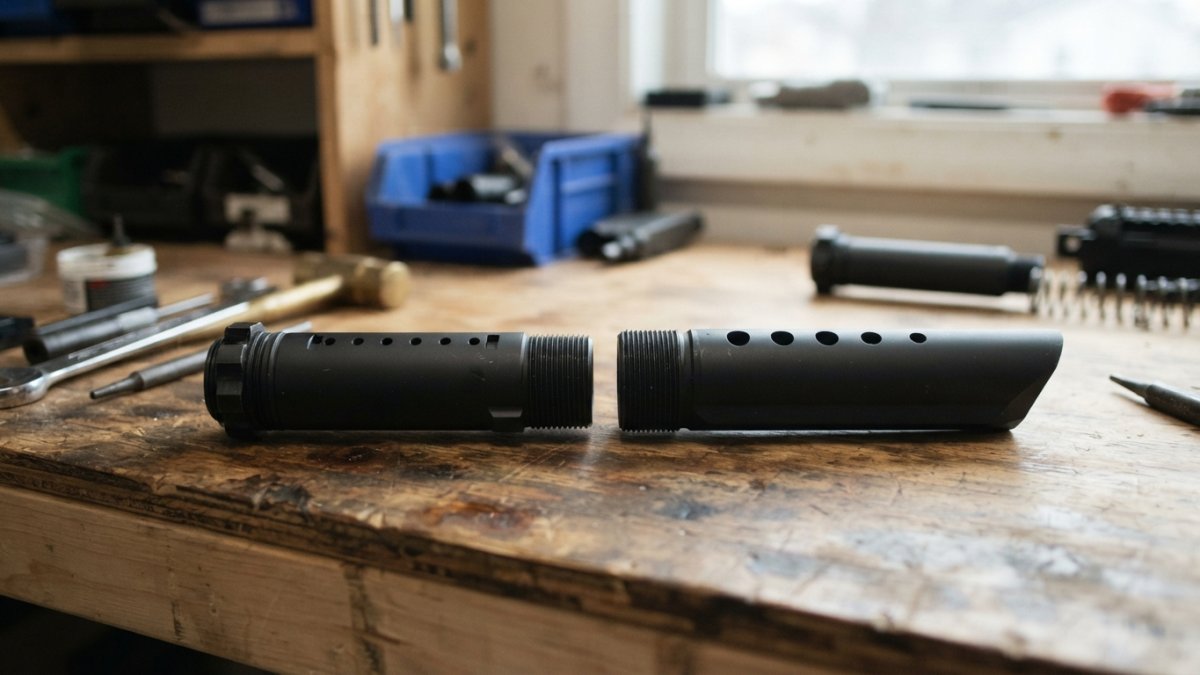
| Rear profile | Often tapered | Often straight-walled |
How to Measure an AR-15 Buffer Tube
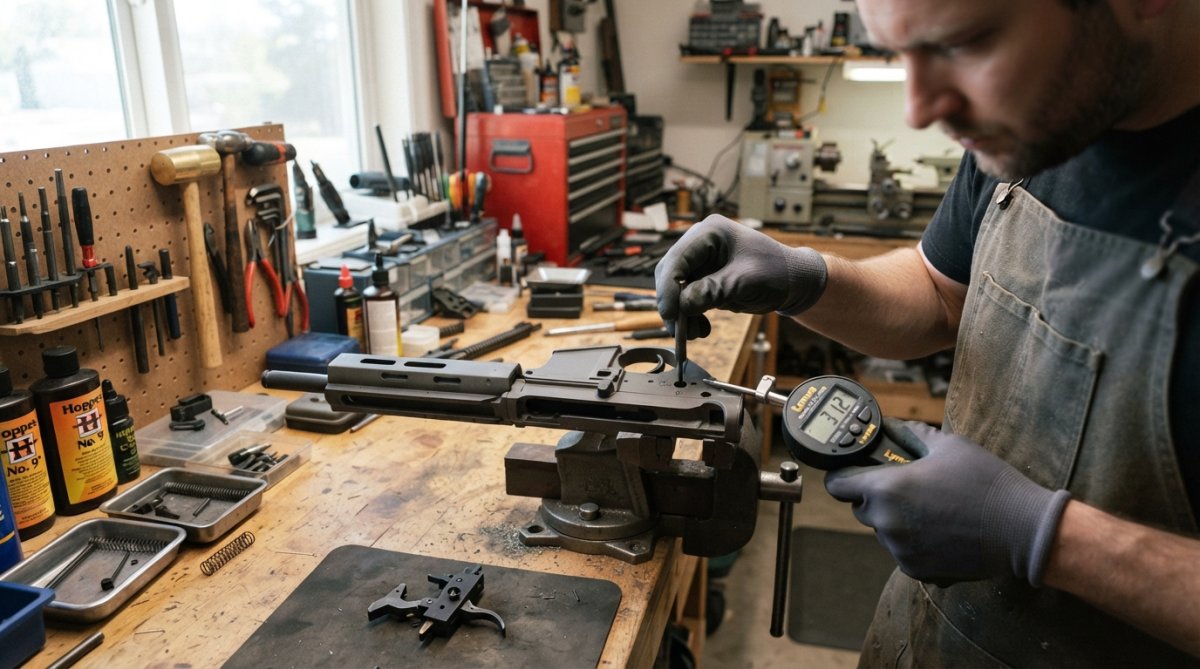
Measuring an AR-15 buffer tube takes about two minutes with a caliper. Measure the outside diameter at the stock end, not the receiver end and not the threads. That single reading tells you which pattern you have.
Work through it in this order:
- Remove the stock so the full tube is exposed.
- Close the caliper jaws on the outside of the tube at the rear, near the stock end.
- Read the diameter and compare it to 1.148 and 1.168 inches.
- Measure in two spots, 90 degrees apart, to catch an out-of-round tube.
- Repeat at the receiver end to confirm the tube is not damaged.
Watch out: measuring across the threads or at the receiver end gives a false reading and the wrong stock order. The stock end is the only number that matters.
How to Identify a Mil-Spec Buffer Tube
A mil-spec buffer tube reads approximately 1.148 inches at the stock end. If your caliper lands closer to 1.168 inches, you have a commercial tube. That single number is the most reliable identifier, but getting a trustworthy reading takes the right tool and the right measurement points. This walkthrough gives you both, plus visual checks to confirm what the caliper tells you.
Tools and measurement points
Use a digital caliper with 0.001-inch resolution. A cheap fractional caliper will not resolve the 0.02-inch gap cleanly, and a tape measure is useless here. Measure the outside diameter at the stock end of the tube, roughly 1/4 inch forward of the rear edge, on the smooth cylindrical section. Do not measure across the threads, the receiver end, or the raised guide ribs some tubes have for stock alignment. Those surfaces give false readings.
Take two readings 90 degrees apart at the stock end. If they differ by more than about 0.002 inches, the tube is out of round or your caliper is not square to the axis. Re-seat the jaws and try again. A tube that consistently measures out of round should be replaced rather than matched to a stock.
Visual checks as a second signal
When the caliper reading is ambiguous, look at the rear profile and the threads. Visual cues such as thread finish and rear profile can help confirm a caliper reading. Treat visual checks as confirmation, not proof, since tube finish and profile can vary by maker.
What the label will not tell you
A “mil-spec” label on a stock or tube does not guarantee a match with a “mil-spec” label from a different maker. The term describes a dimensional pattern, not a certification or a universal fit standard. The only reliable check is the actual diameter of the part in your hand. If you are buying a replacement stock, measure your existing tube first and confirm the stock’s stated interface before ordering.
Measuring at the receiver end or across the threads is the most common identification mistake. Those dimensions are shared between patterns and will send you toward the wrong stock.
For a deeper look at what mil-spec actually means across the platform, read our guide on what a mil-spec AR-15 lower receiver is.
AR-15 Stock Compatibility with Buffer Tubes
AR-15 stock compatibility comes down to a simple rule: mil-spec stocks fit mil-spec tubes, commercial stocks fit commercial tubes. There is no adapter and no shim that makes this safe to mix. The stock’s internal bore is machined to match one diameter.
- Mil-spec stock on mil-spec tube: correct fit, minimal wobble.
- Commercial stock on commercial tube: correct fit, slightly larger profile.
- Commercial stock on mil-spec tube: loose, rattles, poor lockup.
- Mil-spec stock on commercial tube: binds or will not install.
If you are fitting a lower and want the full compatibility picture, see our MKE lower receiver compatibility guide.
Construction and Manufacturing: More Than Just Diameter
The commonly cited diameters are nominal figures rather than guarantees, and actual parts vary within a maker’s tolerance band.
Nominal versus actual dimensions
The commonly cited figures are nominal dimensions, and actual parts vary within a tolerance band set by the maker. A tube at the top of its tolerance range paired with a stock at the bottom of its range can feel tight even when the pattern matches. A tube at the bottom of its range paired with a loose stock can rattle. This tolerance stack is what bites builders who trust labels instead of measuring the part.
Why the 0.02-inch figure can vary
The 0.02-inch difference is a useful rule of thumb, not a precise specification. Different makers hold different tolerances, so measured diameters can fall outside the commonly cited figures. The gap between a tight commercial tube and a loose mil-spec tube can shrink to a few thousandths of an inch, which is why eyeballing fails and calipers matter. For fitment purposes, the stock-end diameter is the number to trust, and the pattern label is secondary.
Threads, receiver end, and shared dimensions
The stock end is where the two patterns differ in ways that affect stock fit. Do not use thread appearance as your primary identifier; use it only to confirm a caliper reading.
Measure the actual part, not the packaging. A “mil-spec” label on a stock and a “mil-spec” label on a tube from different makers do not guarantee a match. The caliper reading at the stock end is the only reliable check.
A common mistake is assuming a “mil-spec” label on a stock guarantees a match with a “mil-spec” label on a tube from a different maker. Check the diameter yourself and you avoid the whole argument.
AR-15 Buffer Tube Replacement: What to Know Before You Swap
Replacing an AR-15 buffer tube means matching the new tube to the stock you plan to run, and matching the tube length to your buffer and spring. A carbine-length tube is the common collapsible setup; rifle-length tubes are a different system entirely and are not interchangeable with collapsible stocks.
Before you swap, confirm three things:
- Tube pattern: mil-spec or commercial, measured at the stock end.
- Tube length: carbine or rifle, matched to your buffer and spring.
- Receiver fit: the threaded end should start by hand and torque down cleanly.
Watch out: cross-threading the receiver end during installation can damage the lower’s threads. Start the threads by hand and stop the moment resistance feels wrong.
If you are mid-build and want to avoid tolerance-stacking problems, our MKE lower receiver fitment guide for builders is a useful reference.
Which Buffer Tube Should You Choose for Your Build?
For most builds, choose mil-spec. The mil-spec pattern is the default for M4-style collapsible setups. Choose commercial only when you already own a commercial stock or you are matching an existing commercial tube.
Our decision logic:
- New build, no stock yet: go mil-spec.
- You already own a commercial stock: match it with a commercial tube.
- Clone or budget build: measure twice, buy once, and confirm the pattern before ordering.
- Replacing a tube only: measure the old tube at the stock end and match it exactly.
For broader component selection guidance, see our high performance firearm build tips.
The 0.02-inch gap between mil-spec and commercial buffer tubes is small, but it decides whether your stock locks up or fights you. Measure the stock end, match the pattern, and check the length against your buffer and spring before you order. Poly Pew offers firearm components and accessories for enthusiasts, including aluminum MKE lowers, drop-in trigger systems, and super safety kits. Get your Flatties here and start your next build with parts that fit the first time.
Frequently Asked Questions
What is the difference between a mil-spec and commercial buffer tube?
The main difference is the outside diameter at the stock end. Mil-spec tubes measure about 1.148 inches, while commercial tubes measure about 1.168 inches. That 0.02-inch gap changes which stocks fit. Mil-spec tubes often use rolled threads, while commercial tubes may use cut threads. Construction and manufacturing methods can also vary, but the diameter is the spec that decides stock compatibility.
How can you tell whether an AR-15 buffer tube is mil-spec or commercial?
Measure the outside diameter at the stock end with a caliper. If it reads close to 1.148 inches, it’s mil-spec; close to 1.168 inches means commercial. You can also try a known stock: a mil-spec stock will be loose on a commercial tube, and a commercial stock won’t slide onto a mil-spec tube. When in doubt, measure rather than guess.
Are mil-spec and commercial buffer tubes interchangeable?
The tubes themselves often thread into the same receiver, but the stocks are not interchangeable. A mil-spec stock will not fit a commercial tube, and a commercial stock will not fit a mil-spec tube. If you replace the tube, you usually need a matching stock. Check both tube and stock specs before buying to avoid a loose or non-fitting assembly.
Will a mil-spec stock fit a commercial buffer tube?
No. A mil-spec stock is sized for a 1.148-inch tube, so it will be too loose on a 1.168-inch commercial tube and may wobble or fail to lock. Trying to force it can damage the stock or tube. Always match the stock to the tube type. If you’re unsure which tube you have, measure the outside diameter at the stock end first.
Does the buffer tube type affect the rifle’s function?
The tube type mainly affects stock fit, not function. Both mil-spec and commercial tubes serve the same role: housing the buffer and spring and supporting the stock. As long as the tube is the correct length for your buffer system (carbine, mid-length, or rifle) and is installed to the proper depth, the rifle should cycle normally. The diameter difference is a compatibility issue, not a performance one.