Last Updated: November 21, 2026
Quick Summary
MP5 clone charging handle upgrades compared come down to three variables: length, grip texture, and clone-by-clone fitment at the cocking tube. Extended knurled handles suit fast shooting and gloved hands, compact extended handles suit the MP5K, and standard handles keep a slim profile. Always dry-fit before pinning and check clearance through full bolt travel.
- Extended handles speed up reloads but can foul handguards, catch on gear, and change slung balance.
- Dry-fit the handle with the pin out first; wobble means the shaft-to-tube fit is wrong.
- The UTG extended handle suits a first clone, range gun, or placeholder build on a budget.
- On the MP5K, choose a compact extended handle and go shorter if it fouls your grip.
- Inspect for cracks at the handle base and pin looseness after every few range sessions.
Table of Contents
- Why the MP5 Charging Handle Is the First Upgrade You Should Make
- Extended vs Standard Cocking Handle Length: What Changes in Handling
- Grip Texture, Knurling, and Clearance Around the Handguard
- MP5 Charging Handle Replacement: Installation and Fitment Checks
- UTG MP5 Charging Handle: Budget Option and Its Trade-offs
- MP5K Extended Charging Handle: Short-Barrel Clearance and Grip
- Best MP5 Charging Handle by Use Case: Clone-by-Clone Fitment
- Durability, Breakage, and What to Inspect After Repeated Use
- Frequently Asked Questions
Why the MP5 Charging Handle Is the First Upgrade You Should Make
The charging handle is the first thing you touch and the last thing most builders think about, which is why MP5 clone charging handle upgrades compared side by side matter so much. On an MP5 clone, the cocking handle is your only interface with the bolt, and a stock handle forces an awkward reach over the receiver that slows every reload and malfunction clearance. When we talk about MP5 clone charging handle upgrades compared, the handle changes how the whole gun handles. Below, we break down length, texture, clearance, and clone-by-clone fitment so you can pick the right one the first time.
Extended vs Standard Cocking Handle Length: What Changes in Handling
Extended handles trade a longer lever for a longer reach. A standard cocking handle sits close to the receiver and keeps the profile slim, which suits shooters who run the gun with a support-hand slap.
The trade-off is real. Longer handles can foul handguards, catch on gear, and change the balance of the gun when slung. If you run a slick setup and never rush the bolt, standard length is fine. If you shoot fast, clear malfunctions under pressure, or wear gloves, the extended reach earns its place.
One-Finger vs Two-Finger Operation
One-finger operation means hooking the index finger over the handle and pulling straight back with the wrist. It is fast and keeps your firing hand in place. Two-finger operation, usually the index and middle finger, gives more use and control on a stiff spring or a new build that has not broken in.
Which one you get depends on handle geometry. A short, low-profile handle rewards one-finger work; a longer handle with a wider grip surface lets you stack two fingers without slipping. Pick the handle that matches how you actually run the gun.
Grip Texture, Knurling, and Clearance Around the Handguard
Texture is where cheap handles give themselves away. A knurled handle bites into a gloved hand and stays put when your palms are sweaty.
Clearance is the other half of the equation. An extended handle that rubs a monolithic or wide M-LOK handguard will bind, and a binding handle is worse than a stock one.
MP5 Charging Handle Replacement: Installation and Fitment Checks
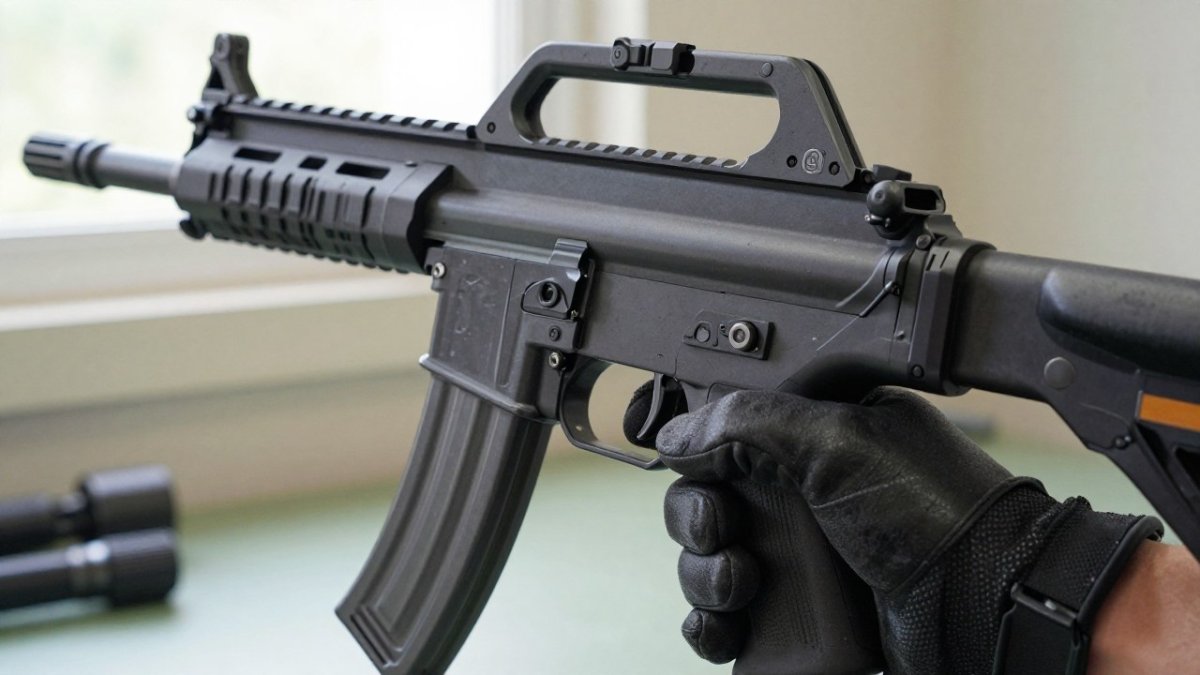
Replacing the handle is a bench job, but the fitment checks are where most problems are created or caught. Most guides list steps without explaining what each step tests, here is the diagnostic logic behind the checklist, plus the clone-specific variables that cause failures.
What the handle interfaces with
The cocking handle does three jobs: it transfers your hand’s force to the bolt carrier, it stays attached under recoil, and it clears everything in its travel path. Each job maps to a specific check.
Force transfer depends on the shaft seating fully in the cocking tube and the head being rigidly attached.
Attachment depends on the pin or cross-pin retention. A roll pin that is slightly undersized for the hole will walk; a pin that is oversized will distort the hole on installation.
Clearance depends on the handle’s path through the full bolt travel, not just its resting position.
Clone-by-clone fitment variables
This is the part generic guides skip. MP5-family clones are not dimensionally identical at the cocking tube, and the variables that matter are:
- Cocking tube diameter and concentricity, varies by receiver maker and by production lot; a handle that fits one tube can be tight or loose in another.
- Tube-to-receiver alignment, a tube welded slightly off-axis changes the handle’s travel path and can cause binding against one side of the handguard.
- Handguard internal profile, wide M-LOK and monolithic handguards reduce the gap more than factory slim handguards; measure the gap at the handle’s widest point, not at the shaft.
- Lower and trigger group fitment, a lower that sits off can shift the bolt carrier’s path and, with it, the handle’s travel; if the handle binds only after a lower swap, the lower is the suspect.
If you are chasing a fitment problem that shows up as binding or off-center travel, our breakdown of MP5 clone lower fit issues explains the causes that are not the handle’s fault.
The installation and inspection sequence
- Dry-fit before pinning. Seat the handle on the shaft and check for wobble with the pin out. Wobble means the shaft-to-tube fit is wrong, and pinning will not fix it.
- Check pin alignment. The pin should pass through both holes without force. If it needs a drift and a hammer, the holes are misaligned, stop and identify which side is off.
- Cycle by hand through full travel. Feel for binding at the rear of the stroke, not just at rest.
- Check accessory clearance. Optics rails, rail-mounted lights, and wide handguards all move the geometry; measure the handle’s path against every accessory you plan to run.
- Test with your actual gloves. A handle that indexes cleanly bare-handed can slip with a gloved finger.
- Fire one magazine, then re-inspect. Look for pin walk, finish wear at the shaft shoulder, and new contact marks on the handguard.
Troubleshooting by symptom
- Handle wobbles at rest, shaft-to-tube fit; check shaft diameter against the tube, not the pin.
- Handle binds at full rearward travel, handguard or accessory clearance; measure the gap at the widest point of the head.
- Pin walks under recoil, pin retention; verify pin diameter and consider a retention upgrade rather than a larger pin.
- Handle feels gritty through the stroke, tube concentricity or debris; inspect the tube interior before blaming the handle.
- Handle contacts the optic rail, geometry conflict; a shorter head or a different rail height solves it, not force.
Watch out: if the handle binds only after you install a lower or a handguard, the handle is probably not the problem, diagnose the changed part first, because fitting the handle to compensate hides the real issue.
UTG MP5 Charging Handle: Budget Option and Its Trade-offs
The UTG handle is a Leapers/UTG extended cocking handle for the MP5 family.
Where budget handles earn scrutiny is at the interface, not the grip. The two failure points to inspect on any low-cost handle are the shaft-to-head junction and the pin retention.
Fitment is the other variable.
Use-case verdict: the UTG makes sense on a first clone, a range gun, or a build where the handle is a placeholder until you settle on a final configuration. If you are still assembling a low-cost build, our roundup of budget firearm upgrade kits puts the handle in context against other first purchases.
Verify shaft diameter and pin hole alignment on your specific cocking tube before you commit.
MP5K Extended Charging Handle: Short-Barrel Clearance and Grip
The MP5K changes the math. Its shorter receiver and tighter profile leave less room around the cocking handle, so an extended handle has to be chosen with clearance in mind. A handle that works on a full-size MP5 can crowd the MP5K’s handguard or sit too close to your support hand.
On the K, grip matters as much as length. A compact extended handle with a well-placed knurled surface gives solid purchase without adding bulk you cannot afford. Test the pull with the gun shouldered and close in, because the K is often run differently than a full-size gun.
Best MP5 Charging Handle by Use Case: Clone-by-Clone Fitment
There is no single best MP5 charging handle, only the best one for your clone and your use. Fitment varies by receiver maker, and the handle that shines on one build can need work on another.
Here is how we would match handle to use case:
| Use Case | Handle Type | Priority |
|---|---|---|
| First clone on a budget | UTG extended handle | Low cost, easy install |
| Fast shooting and reloads | Extended, knurled handle | Reach and grip |
| MP5K and short builds | Compact extended handle | Clearance and control |
| Gloved or wet-hand use | Half-knurled or full-knurled | Nonslip texture |
| Slick, low-profile setup | Standard handle | Slim profile |
If you are still deciding whether a clone is worth the investment at all, our guide on whether MP5 clones are worth the money covers the bigger picture before you start buying parts.
Optics Rails and M-LOK Handguards: Clearance Matters
Adding an optics rail or an M-LOK handguard changes the space around the charging handle, and that is where fitment surprises come from. A rail-mounted optic or light can sit close to the handle’s path, and a wide handguard can reduce the gap you counted on. Measure the handle’s full travel against every accessory before you commit. If you are planning an optic, our guide to the best MP5 optic mounts for clones pairs well with handle selection, since both depend on the same clearance.
Durability, Breakage, and What to Inspect After Repeated Use
Handles break at the root, where the handle meets the cocking tube, and at the roll pin or attachment point. Repeated hard pulls, especially two-finger yanks on a stiff spring, stress that joint.
Inspect after every few range sessions:
- Look for cracks or stress marks at the base of the handle
- Check the attachment point for looseness or wallowing
- Feel for wobble when you pull the handle by hand
- Watch for unusual wear where the handle meets the tube
A common mistake is ignoring a slightly loose handle until it fails mid-string. Catch it early and swap it before it strands you.
The right charging handle turns a clumsy clone into a gun you can run with confidence, and the wrong one fights you every reload. Poly Pew builds precision components for custom builds, including aluminum MKE lowers, drop-in trigger systems, and Super Safety kits.
Frequently Asked Questions
Do different charging handles make a difference on an MP5 clone?
Yes, mostly in leverage and grip. An extended handle gives you more reach and a larger surface for one-finger or two-finger operation, while a knurled or half-knurled texture reduces slip when your hands are sweaty or gloved. The difference is most noticeable on short-barrel MP5K builds and on clones with monolithic handguards that crowd the handle. Internal geometry stays the same, so the upgrade is about ergonomics and clearance, not cycling speed.
Are MP5 and MP5K charging handles interchangeable?
The cocking handle tube and interface are shared across the MP5 family, so many aftermarket handles fit both. The real limit is clearance: an extended handle that works fine on a full-size MP5 with a standard handguard can contact an M-LOK handguard or optics rail on an MP5K. Test fit with the handguard installed and cycle the action by hand before you commit. Check the manufacturer’s fitment notes for your specific clone receiver.
Can an aftermarket charging handle affect MP5 clone reliability?
A well-made handle should not change reliability because it does not touch the bolt, extractor, or recoil spring. Problems show up when a handle is out of spec: binding in the cocking tube, a groove that is too tight, or a set screw that backs out under recoil. Inspect for cracks at the root of the handle and check that the handle moves freely through the full travel. If the action feels gritty after installation, stop and check fitment before firing.
What should you compare when choosing an extended MP5 charging handle?
Compare four things: length and reach, texture (knurled vs half-knurled vs smooth), clearance against your handguard and optics rail, and material quality. Measured dimensions matter more than photos. Also check whether the handle is one-piece or assembled, since set-screw designs can loosen. For a first upgrade, a half-knurled extended handle is a safe middle ground. Verify fitment on your receiver before buying any handle.